Latvian public had to live through two referendums last August. In representative democracy there is no real need after referendums, because referendums would intrinsically show that MP's are unable to reach a consensus in some issue. Perhaps my conclusion would sound to harsh, but "the referendum culture" is viable only in Switzerland and in some Western states in the US. Referendum traditions have developed there as combination of historic development and structural absence of the established political system. Thus, the referendum culture does not really exist in other West European states, because the legitimacy is founded in the quality of the representative democracy. For example, West Germany after passing its Grundgesetz in 1949 specifically tried to avoid developing the referendum culture. Simply its recent past and the example of an Austrian from Linz achieving his political summit through techniques of plebiscite democracy made the FRG politicians to conclude that referendums would only be giving bonuses to demagogues (prämie für Demagogen). Regardless of the suspicious FRG politicians referendums have been making small inroads into the political culture of the Central and East European states.
Grand issues of independence or joining the EU are obvious questions for plebiscitary referendum to take place. When there are issues of language, security or pension laws discussed in referendum it obviously raises the issue - why politicians in Latvia cannot agree on such issues in the parliament? Answer is simple, while issue of language law or non-privatization of the energy monopoly (Latvenergo) took place during the 1990's, when the political system was still democratising, the questions of security and pension laws as well as constitutional amendments in August 2 were caused due to consequences of stolen elections in October 2006. Since August 2006 the trust in democratically elected representatives in Latvia has started its downward slope.
Latvian political culture shows a specific trend. There is a clear correlation between the slump of governing elite's credibility since the last elections, and increased activity of civil society through referendum campaigns. Namely, the opposition parties in Latvia are not taken into consideration. Simply the governing coalition follow the abstract and taken out of context notion of "democracy being simply the majority rule". Instead of developing the culture of debates in the parliament, and consolidating ideologically distinguishable parties in left-right or freedom-authority nexus there is nothing of this kind in Latvia. The totalitarian and Karl Schmidt'ian notion of inability of the representative democracy to represent the interests of the pople, and thus, the culture of caring about the abstract nation (tauta, das Volk, narod, rahvas) still prevails in public domain in Latvia. Such culture inescapably fosters the culture of populist politicians. Populism is the only way to achieve the recognitions in the Latvian utterly stagnated political establishment.
There are now two new parties formed. The Civic Union is considered as the right wing conservative party, while the Society for Other Politics (SCP) is a socially liberal party. Onset of both parties is intimately connected with referendum issues, because for an opposition member there is no way to brake out of the mediocre discussion culture in the Latvian Saeima. Thus, both new political parties were active in supporting the referendum activities. The Civic Union and also the SCP founders were actively supporting the cause for the referendum of the August 2, that would have given the 1/10 of the Latvian electorate the right to initiate the procedure of dissolving the parliament. The Civic Union was not supporting the August 23 referendum campaign where the SCP was the initiator of the campaign together with the Social Democratic party and the Pensioners Federation.
The first referendum campaign failed because the needed quorum was about 150 000 short. Organizers of the referendum after their loss blamed the Central Election Bureau for organizing the referendum in summer, when most of the folks are vacationing. This is very dubious excuse, because the initiators of the referendum (Free Trade Unions) should have known the procedure. The procedure clearly states, that after the needed signatures for initiating referendum campaign are submitted to the parliament and parliament gives it a go, the referendum should take place no earlier than a month or no later than two months after his date. Thus, if the Trade Unions really wanted this referendum to succeed, then they could submit the signatures in Autumn and referendum would have taken place in early Winter. Anyway, the date is not the only issue. The fact that about 900 000 eligible voters did not budge shows very much that the traditional population did not comprehend the significance of the constitutional amendments, and also that the same population either is totally alienated or their basic material needs are met (bottle of vodka, bread and sausage and NO WAR is enough as the traditional proverb goes:).
The second referendum campaign would have made the present governing coalition finally start reforming the Latvian stagnated fiscal policies. Unfortunately, the second election campaign was also about 100 000 signatures short. In the last moment the Pensioners Federation and its outspoken leader Aina Verza withdrew their support. The reason for the lack of support of the prime "potential beneficiaries" was unexpected. The government and the ministry of welfare was creating the horror scenarios explaining that the possibly successful referendum campaign would destroy present pension payment system. Thus, the traditional Latvian voters listened to the simple reflex of survival, because the trauma of continuous transformations since the collapse of the USSR is too heavy. I personally met several elderly ladies in Salaspils who were openly saying that they want to believe in the new proposals of the SCP and referendum organizers, but they better stick to the old ways, because "they at least know that system and after all their representatives would not allow them to die immediately" (funny isn't it:). The referendum organizers did indeed envisage termination of the existing governmental practice to borrow from the social fund whenever there was a need to have a balanced budget. the latter practice allows all these years the Latvian government to continue its status quo governance, and not to worry about the burgeoning government apparatus. Borrowing from the social fund at times when about 200 000 pensioners have hardships in keeping ends meet to support the burgeoning class of administrators is both immoral and utterly irresponsible.
Only about 325 000 people considered it so, whilst the rest of the Latvian electors trusted promises of the government to rise the minimum unemployment rate from 45 to 60Ls prior referendum, and to act decisively if the economy should stall. Now the economy has really stalled (even the Bank of Latvia envisages the 0,5GDP growth this year, and that is the fall from 13GDP growth in 2007(!)) and it appears that both the Prime minister and the Minister of Welfare lied about the rise of the minimum rate of unemployment benefit, and also about decisive actions at times when economy stalls.
This Wednesday Kas notiek Latvijā TV emission clearly showed that Ivars Godmanis was lying. Amidst his number crunching tirades Valdis Dombrovskis (MEP-JL) and Gatis Kokins (SCP) asked the head of the cabinet, why the government does not keep their promises? The PM exploded in rage and suggested that both politicians should better learn mathematics... .
Instead of having a smart economist to support his arguments, he had a visibly drunk (a sober person would not constantly slip his tongue) Minister of Finance Atis Slakteris (TP) next to him. The traditional number crunching, ridiculous shallowness of arguments, and his intrepid style of answering questions makes me reckon that the PM still has not learned to delegate responsibilities, and therefore he does not see the broad picture of governing the EU state. The fact, that PM announced the freeze of promised salary rise for teachers, doctors, and policemen in 2009 prior consultations with the employers confederation heads and the trade union representatives makes me to assume that the inside deals of the top notch politicians and civil servants are more important than the social stability, unfortunately. Also, rather ironically, Mrs Verza from the Pensioner's Federation anounced this week that they will probably have to call for their member's emergency caucus, because the government had lied about the determinantion to increase unemplyment benefits. Now the referendum is over, and with it the only possible way to force the MP's and ministers to govern responsibly. Thus, the only rational issue one may expect from the present coalition government is to continue to sustain their own welfare. And all this amidst expectations of striking doctors, teachers and policemen.....very, very sad.
P.S. The news just came out that the Social Integration secretariat with 48 civil servants (it had only two (!) employees in 2002, when it was founded) instead of doing their assigned work use taxpayers monies to employ private contractors for doing their job... . Also the top notch civil servants remuneration system makes the Latvian civil service the second most expensive after Cyprus, huh, uhh. This will definitely make me to write about the civil service, remuneration system and rationale of governance in Latvia next time.
Sunday, September 14, 2008


Tuesday, September 9, 2008
The Autumn Season
Almost a month has passed since I last dropped a line into my blog. August transformed "traditional" international affairs in the post-Soviet space and Europe at large. After ominous 08.08.08 events the EU leaders should realize that the post-modern political system, where such virtues as peaceful and rationally calculated relations between nations and other political actors, omnipotence of human rights, and win-win games prevail, is utopian without basic mechanisms of modern statecraft and possession of hard power. The EU is the biggest consumer market and the most populous Western state, but militarily the EU is a dwarf. Inability to agree on common energy policy and EU military dwarfishness explains the EU's inability to fully exert its potential influence, as well as inadequately bullying attitude of the Kremlin's two-headed leadership. Alright, and shall return to the transforming international affairs this weekend, but why was I silent for a month? After all there were certain issues I wanted to write about before, but then reconsidered my plans and decided to give myself a brake and have some time for recollection. After all, the life still goes on, and after personal recollections I feel better equipped to analyze and write instead of doing it the other way around.
After a busy end of the august preparing for the new academic year and managing personal affairs I am back in Salaspils and busy managing my time. The August weather was miserable, and I had not seen such a rainy end of the summer in Baltics in my "short" life:) Actually, there was a monsoon like rain in Riga two days ago, and some meteorologists reckoned that it was probably leftover from the tropical storm "Hannah". Personally I feel that the global weather is changing, because winters are becoming warmer, and we have more rain in the Baltic States. The political scene, quite the opposite, is as stagnated in Latvia as before.
First, the second referendum amending the pension laws did not reach the needed quorum of 475 000 votes, because only about 325 ooo voters appeared at the voting stations. It seems that today's young persons believe that they will be young forever and will somehow skip the pension age. Second, the governing coalition continues its free fall, because the collapsing economy and world economy outlooks do not provide any good news. While, the news are bad the incumbent PM could finish structural reforms and slim the bloated government, but he already announced that he does not want to risk with loss of income for hundreds of bureaucrats families.
Last week "Latvijas fakti" published the latest party ratings and there are neither surprises nor good news. The public considers Latvian governors illegitimate, because only barely 15% support the opposition Reconciliation Centre (SC) and New Era (JL) parties. The coalition parties according to August data would not even squeeze into the parliament. The number of undecided and alienated voters has increased, and that is no good news. Major reasons for such a negative public opinion are disastrous news about the state of mismanaged Latvian economy. Last week PM Godmanis announced that government would not be able to keep their promise, thus all (!) public sector workers pay rise in 2009 is terminated. Unfortunately Ivars Godmanis made a public relations blunder, because he announced such bombastic news prior the tripartite meeting with employers associations and trade unions, and that angered both parties.

After a busy end of the august preparing for the new academic year and managing personal affairs I am back in Salaspils and busy managing my time. The August weather was miserable, and I had not seen such a rainy end of the summer in Baltics in my "short" life:) Actually, there was a monsoon like rain in Riga two days ago, and some meteorologists reckoned that it was probably leftover from the tropical storm "Hannah". Personally I feel that the global weather is changing, because winters are becoming warmer, and we have more rain in the Baltic States. The political scene, quite the opposite, is as stagnated in Latvia as before.
First, the second referendum amending the pension laws did not reach the needed quorum of 475 000 votes, because only about 325 ooo voters appeared at the voting stations. It seems that today's young persons believe that they will be young forever and will somehow skip the pension age. Second, the governing coalition continues its free fall, because the collapsing economy and world economy outlooks do not provide any good news. While, the news are bad the incumbent PM could finish structural reforms and slim the bloated government, but he already announced that he does not want to risk with loss of income for hundreds of bureaucrats families.
Last week "Latvijas fakti" published the latest party ratings and there are neither surprises nor good news. The public considers Latvian governors illegitimate, because only barely 15% support the opposition Reconciliation Centre (SC) and New Era (JL) parties. The coalition parties according to August data would not even squeeze into the parliament. The number of undecided and alienated voters has increased, and that is no good news. Major reasons for such a negative public opinion are disastrous news about the state of mismanaged Latvian economy. Last week PM Godmanis announced that government would not be able to keep their promise, thus all (!) public sector workers pay rise in 2009 is terminated. Unfortunately Ivars Godmanis made a public relations blunder, because he announced such bombastic news prior the tripartite meeting with employers associations and trade unions, and that angered both parties.
The picture is with a rather bad qulity, thus for those of you who follow Latvian politics the ratings in Latvian are:
Saskaņas centrs - 10.5%;
Jaunais laiks - 5.8%;
Zaļo un Zemnieku savienība - 4.8%;
Tautas partija - 4.5%;
LPP/LC - 3.7%;
Par cilvēka tiesībām vienotā Latvijā - 3.6%;
Pilsoniskā savienība - 3.1%;
Tēvzemei un brīvībai/LNNK - 2.9%;
Aigara Štokenberga veidotā partija - 2.6%.
Swing voters - 34.1%
Alienated voters - 19.7%
Wednesday, August 13, 2008
August 2008 - transforming international affairs
Russian invasion of Georgia that Kremlin's bosses euphemistically call "peace enforcement mission" has changed modus operandi of international politics. Response of the US leadership was unexpectedly harsh. Considering the fact that its the prime vacation time the response and actions of the EU27 were well coordinated. Furthermore the coordination of response between the US and its European allies is laudatory. Even a personal friend of the Russian PM Mr Sylvio Berlusconi had to change his former rhetoric, and give in to the present call for European unity in approaching Russia.
Reappearance of Russian tanks on streets of the European country since the Prague spring 1968 , and vicarious demands to topple the current Georgian government shows that Kremlin policy makers still have not changed the thinking patterns of the Cold War era. The Russian Federation and particularly its PM won a Pyrrhic victory so far. Mr Putin' s wish to consolidate "his energy empire" backfired, because the US and the EU have vital interests securing alternative energy sources from the Caspian Sea region. The whole mechanism of interdependence between the Russian Federation and the EU should be reassessed now. Wholesome interdependence cannot be played according to the zero - sum game rules that the former Russian presidency played for the last eight years. The latest events in Georgia clearly show that Kremlin's policy makers still stick to the old paradigms of structural realism, and that the modern ideas of international relations are foreign to them.
The weight of Kremlin power and its cynical political games have blinded Mr Putin personally. The Russian PM probably thinks that all rulers should act similarly to him, and that probably explains his irritation about the personality of Mr Saakashvili and his irresponsible remark about Mr Putin. After Kremlin invaded other member of its own creation, the Commonwealth of Independent States (CIS), the Republic of Georgia slammed the doors of the CIS. Actions of Kremlin were thus poorly staged, that even its staunchest autocratic allies and none (!) of the CIS members supported Kremlin's adventures.
The forthcoming months prior the US presidential elections have coincided with further determination of the balance of power in Kremlin. It will be a time when a new modus vivendi between the US and Russia will be formed. Also the US presidential candidates McCain and Obama are busy positioning themselves vis-a-vis Russia.
The EU member state presidents from Poland, Estonia, Lithuania and the Ukrainian president were in Tbilisi to support Georgian people to withstand the dire situation their country has found itself. Polish, Baltic and Ukrainian leaders have fresh memories about the harshness of Soviet yoke. They understood, that leaving the irresponsible Kremlin bear unattended in Georgia will only intoxicate the beast and then none of the neighboring countries around Russia can feel safe. Apparently Polish, Ukrainian and 3B representatives were not happy with the initial draft of the Sarkozy brokered peace initative, thus came their joint statement.
The French President's brokered plan was accepted by both warring parties after all. The cease fire is still fragile, Russian forces are still on the Georgian soil where the former have even established illegal checkpoints. There is the NATO emergency session planned for the next Tuesday, and after presidential orders the Secretary of State is visiting Paris and Tbilisi. In spite of the vacation time many Western statesmen are forced to act, while some leaders are still in Beijing.
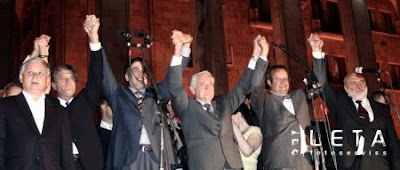
Q: Where is the Latvian president?
Photo: Leta
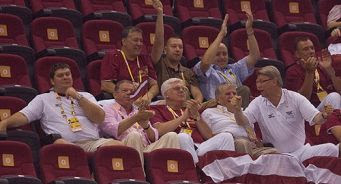
Estonian and Lithuanian presidents announced that they will not attend the Beijing Olympic Games. Latvian president was probably tired from the domestic political turmoil, thus he preferred to relax and support Latvian sportsmen/women in Beijing. The US president was at the Beijing Olympics opening ceremony, and then left to Washington D.C. because of his global responsibilities. Nicolas Sarkozy managed to be at the opening ceremony in Beijing, and after leaving home he managed touring Moscow and Tbilisi as the acting head of the European presidency. Finally he brokered the Georgian and Russian peace deal. In Tbilisi French president had a possibility to meet also Polish, Ukrainian, Estonian, Lithuanian presidents and the Latvian prime minister, while the Latvian president was simply not there. If small democracies want to sustain their long term sustainability and be considered as viable partners in international arena, their politicians must be as active as the leaders of great powers. Valdis Zatlers unfortunately did not live up to his responsibilities when at least 600 000 Latvian citizens expected him as little as to morally support fellow Georgians.
Reappearance of Russian tanks on streets of the European country since the Prague spring 1968 , and vicarious demands to topple the current Georgian government shows that Kremlin policy makers still have not changed the thinking patterns of the Cold War era. The Russian Federation and particularly its PM won a Pyrrhic victory so far. Mr Putin' s wish to consolidate "his energy empire" backfired, because the US and the EU have vital interests securing alternative energy sources from the Caspian Sea region. The whole mechanism of interdependence between the Russian Federation and the EU should be reassessed now. Wholesome interdependence cannot be played according to the zero - sum game rules that the former Russian presidency played for the last eight years. The latest events in Georgia clearly show that Kremlin's policy makers still stick to the old paradigms of structural realism, and that the modern ideas of international relations are foreign to them.
The weight of Kremlin power and its cynical political games have blinded Mr Putin personally. The Russian PM probably thinks that all rulers should act similarly to him, and that probably explains his irritation about the personality of Mr Saakashvili and his irresponsible remark about Mr Putin. After Kremlin invaded other member of its own creation, the Commonwealth of Independent States (CIS), the Republic of Georgia slammed the doors of the CIS. Actions of Kremlin were thus poorly staged, that even its staunchest autocratic allies and none (!) of the CIS members supported Kremlin's adventures.
The forthcoming months prior the US presidential elections have coincided with further determination of the balance of power in Kremlin. It will be a time when a new modus vivendi between the US and Russia will be formed. Also the US presidential candidates McCain and Obama are busy positioning themselves vis-a-vis Russia.
The EU member state presidents from Poland, Estonia, Lithuania and the Ukrainian president were in Tbilisi to support Georgian people to withstand the dire situation their country has found itself. Polish, Baltic and Ukrainian leaders have fresh memories about the harshness of Soviet yoke. They understood, that leaving the irresponsible Kremlin bear unattended in Georgia will only intoxicate the beast and then none of the neighboring countries around Russia can feel safe. Apparently Polish, Ukrainian and 3B representatives were not happy with the initial draft of the Sarkozy brokered peace initative, thus came their joint statement.
The French President's brokered plan was accepted by both warring parties after all. The cease fire is still fragile, Russian forces are still on the Georgian soil where the former have even established illegal checkpoints. There is the NATO emergency session planned for the next Tuesday, and after presidential orders the Secretary of State is visiting Paris and Tbilisi. In spite of the vacation time many Western statesmen are forced to act, while some leaders are still in Beijing.
Q: Where is the Latvian president?
Photo: Leta
Estonian and Lithuanian presidents announced that they will not attend the Beijing Olympic Games. Latvian president was probably tired from the domestic political turmoil, thus he preferred to relax and support Latvian sportsmen/women in Beijing. The US president was at the Beijing Olympics opening ceremony, and then left to Washington D.C. because of his global responsibilities. Nicolas Sarkozy managed to be at the opening ceremony in Beijing, and after leaving home he managed touring Moscow and Tbilisi as the acting head of the European presidency. Finally he brokered the Georgian and Russian peace deal. In Tbilisi French president had a possibility to meet also Polish, Ukrainian, Estonian, Lithuanian presidents and the Latvian prime minister, while the Latvian president was simply not there. If small democracies want to sustain their long term sustainability and be considered as viable partners in international arena, their politicians must be as active as the leaders of great powers. Valdis Zatlers unfortunately did not live up to his responsibilities when at least 600 000 Latvian citizens expected him as little as to morally support fellow Georgians.
A: The president with his buddies (Aigars Kalvītis & Co) is in Beijing watching basketball
Photo: Aivars Liepiņš
Tuesday, August 12, 2008
Impasse or the impossible Georgian affair? (updated)
 The Russian invasion of Georgia that Kremlin's bosses euphemistically call "peace enforcement operation" is turning hot. Just happened to watch the joint press conference of the Russian Minister of Foreign Affairs Mr Serguei Lavrov, and OSCE acting head the Finnish Minister of Foreign Affairs Mr Alexander Stubb on BBC. Aswers of the OSCE acting head were short, concise and diplomatic. However, the tone of the Russian Foreign Minister was grim when asked about possibility to find a solution to the present conflict. The Russian official simply reiterated announcements of the Russian PM (Putin), the Head of the majority United Russia Party and Speaker of the Russian Duma (Gryzlov) and Federation Council (S. Mironov) - that the current leadership of the Republic of Georgia must leave the office(!!!). After the collapse of the USSR Russia is back in its "near abroad", and without any disguise it acts like a bear in the porcelain shop.
It is just incredulous to hear from the current Kremlin's leadership (in a country without a real press freedom) that the democratically elected president of a neighboring country (Georgia) must step down! Since 1898 Fashoda incident no democracy has ever attacked other democracy in a modern era. It seems that Russia with its questionable behavior wants to officially disqualify itself from the honour to be called democracy for a foreseeable future!
Russian propaganda about the thousands of civilian casualties in the capital of South Ossetia Chinvali have not been proven by any other media channels except the Kremlin's controlled Russian ORT and RTR. Alexander Stubb confirmed that the Finnish president Tarja Halonen has negotiated with her Russian counterpart the right for Alexander Stubb to visit Vladikavkaz (North Ossetia) to asses the magnitude of the Kremlin's called civilian catastrophe. In the meantime Human rights watch, independent and other Russian media channels ask, where are those thousands of civilian casualties, that Kremlin controlled media has been blaming "the Georgian leadership of slaughtering" for days in a row now?
I just had to give an interview to the Latvian Public Radio and the correspondent asked me whether the Russian adventure might spill over to other areas of the former Soviet Union (Crimea in Ukraine, Northern Kazakhstan), and possibly Latvia? My answer was that although imminently unlikely it very much depends on Russian experience in Georgia, and that further actions of Kremlin's bosses will be determined by the outcome of its Caucasian adventure. To support their Georgian colleague in dire times Polish and Estonian presidents together with their Lithuanian and Ukrainian colleagues, and Latvian PM flew to Tbilisi, according to Postimees. In the meantime the French president should visit his Russian counterpart today, and later he should be in Georgia to meet president Mikhail Saakashvilli.
News just came in that the Russian president has ordered the Russian military to halt all military operations in Georgia, while the Georgian army has taken defensive positions around the capital city Tbilisi. It is a good news for an instant, while the military actions still take place in Kodori gorge in Abhasia!
It is really interesting how the mutually agreed position on conflict final resolution and future coexistence will be found, because Kremlin bosses have now publicly announced that they do not even want to speak with the current Georgian representatives?
Updated
French and Russian presidents should have a joint press conference any time soon. In the meantime there is a mass rally in Tbilisi. Whilst seeing the body language of public speeches and knowing the high number of ethnic Georgian refugees driven out from their homes in Abhasia and South Ossetia I feel that Kremlin has miscalculated again. With the latest adventure they have made their traditional and historic ally in Caucasus one of their staunchest foe for a long time.
Perhaps the peace will hold after all, and in the long run it will also settle the new development for the post-Soviet space. Rather ominously there were two looks into the future from the Baltic Sea area by Juka Rislaki and Ernests who published their latest cartoons in today's Diena.

Q: Is it a real end of the USSR?
(The Russian army is bombing Joseph Stalin's native town)

Medvedev&Putin: "We are the guarantors of peace and material abundance!"
Soviet ghost: "We feel sorry for the lost superpower"
Saturday, August 9, 2008
Kremlin's adventures in Caucasus are wrong
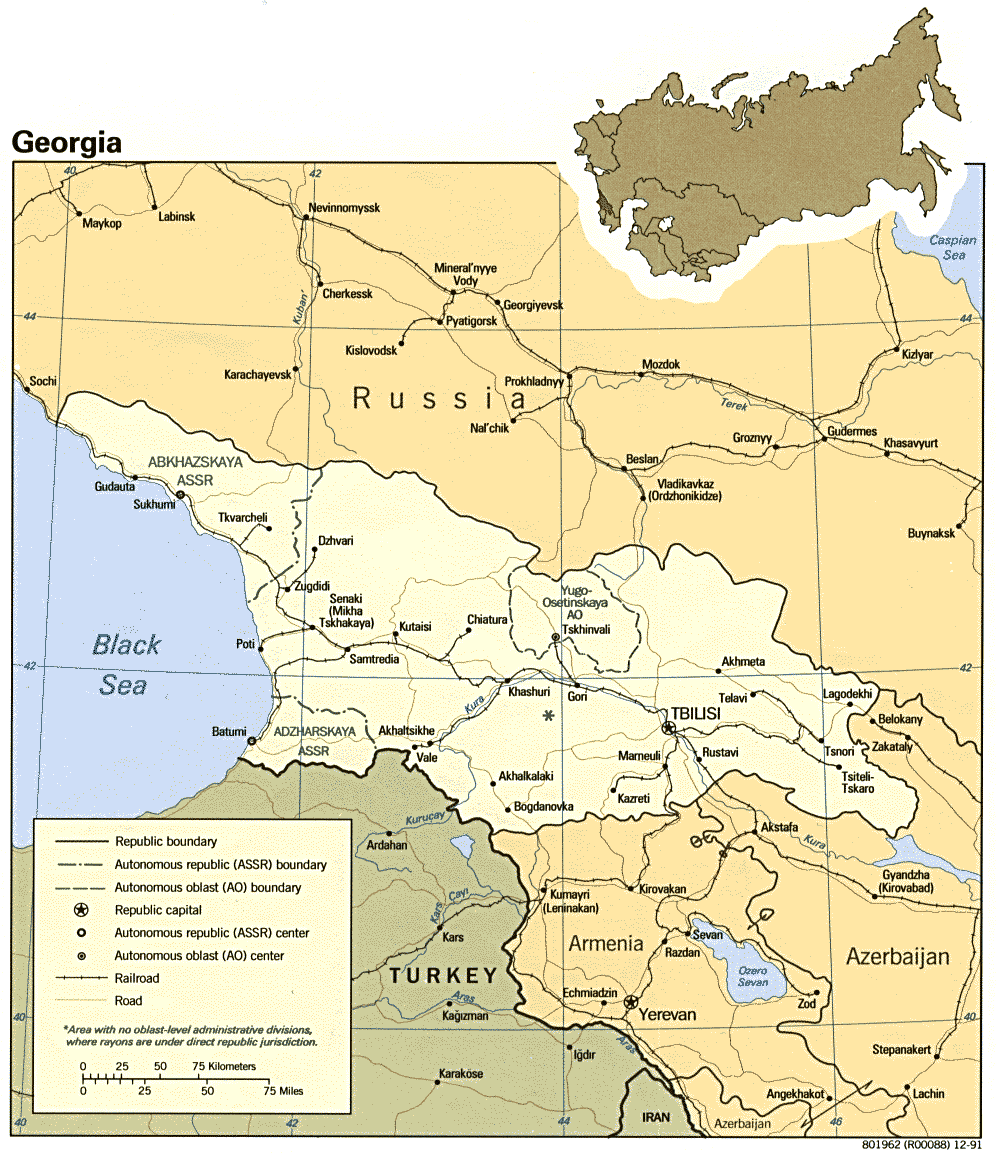
Yesterday I just mentioned about the conflict escalation between the self-proclaimed South-Ossetia and the Republic of Georgia forces. Yesterday night there came rather bellicose announcements from the Kremlin bosses and today there is a full scale war going on between Georgian and Russian forces without even declaring a war. Georgians call it invasion of Russian forces in its territory while Russians call it euphemistically "peace enforcement" operation.

Picture: University of Texas
CNN an BBC have quite a good coverage of the conflict. There is a propaganda and cyber war going on in the meantime. I just watched the interview with the Minister of Foreign Affairs of the Russian Federation Mr Serguei Lavrov. Reporter asked whether the Russian Federation plans to continue with a full scale war with Georgia. Russian minister resolutely answered no. Further on Mr Lavrov rebuked Georgia's president Saakashvilli's statement about the Russian invasion as a preparation for similar adventures in other former Soviet republics and thus undermining the peace efforts in Europe as rubbish. Mr Lavrov was particularly referring to Baltic States. He accused the Baltic States and particular politicians in Estonia for having territorial demands from Russia, and thus undermining the peace in the region.
After hearing such announcements I cannot not to forget the past events, because the timing of the Russian adventure reminds me about the "tradition"of Soviet comrades to annihilate their weaker opponents while world's attention is driven away.
Just to remind you that when Nazis were marching on Paris in June 1940 the Soviet forces occupied the three Baltic States. When Suez crisis was culminating in 1956 the Soviet forces started suppressing Hungarian revolution in Budapest. During the height of the Kuwait war the Soviet paramilitary forces started onslaught on Vilnius TV tower in Lithuania, and later the Latvian Interior Ministry.
So, here we go with the Russian adventure in the brake away region of South Ossetia that has spilled over to Georgia proper. Apparently the Georgian port city Poti has been levelled by the Russian air force, and Georgians reported about gunning down Russian planes. Anyway, the war correspondents will deliver news from the war zones. But I am trying to reach out with this piece to ones who are in Georgia now, or who are in contact with Georgians on ground. You are on the front line now and knoweth that there are thousands of people in the Baltic States who attentively follow what happens in Sakartvelo.
If Nino Dzotsenidze, Sophy Megrelidze in Tbilisi and Armen Grigoryan in Geneva happen to read this peace just respond to this message, and thus I would learn your new e-mails.
Picture: University of Texas
CNN an BBC have quite a good coverage of the conflict. There is a propaganda and cyber war going on in the meantime. I just watched the interview with the Minister of Foreign Affairs of the Russian Federation Mr Serguei Lavrov. Reporter asked whether the Russian Federation plans to continue with a full scale war with Georgia. Russian minister resolutely answered no. Further on Mr Lavrov rebuked Georgia's president Saakashvilli's statement about the Russian invasion as a preparation for similar adventures in other former Soviet republics and thus undermining the peace efforts in Europe as rubbish. Mr Lavrov was particularly referring to Baltic States. He accused the Baltic States and particular politicians in Estonia for having territorial demands from Russia, and thus undermining the peace in the region.
After hearing such announcements I cannot not to forget the past events, because the timing of the Russian adventure reminds me about the "tradition"of Soviet comrades to annihilate their weaker opponents while world's attention is driven away.
Just to remind you that when Nazis were marching on Paris in June 1940 the Soviet forces occupied the three Baltic States. When Suez crisis was culminating in 1956 the Soviet forces started suppressing Hungarian revolution in Budapest. During the height of the Kuwait war the Soviet paramilitary forces started onslaught on Vilnius TV tower in Lithuania, and later the Latvian Interior Ministry.
So, here we go with the Russian adventure in the brake away region of South Ossetia that has spilled over to Georgia proper. Apparently the Georgian port city Poti has been levelled by the Russian air force, and Georgians reported about gunning down Russian planes. Anyway, the war correspondents will deliver news from the war zones. But I am trying to reach out with this piece to ones who are in Georgia now, or who are in contact with Georgians on ground. You are on the front line now and knoweth that there are thousands of people in the Baltic States who attentively follow what happens in Sakartvelo.
If Nino Dzotsenidze, Sophy Megrelidze in Tbilisi and Armen Grigoryan in Geneva happen to read this peace just respond to this message, and thus I would learn your new e-mails.
Friday, August 8, 2008
08.08.08
At 8 o'clock on this ominous day the Beijing Olympics started, and before this event the military confrontation between Republic of Georgia and breakaway Republic, South - Ossetia escalated. Major media channels are covering both events and I really have no wish to comment those events. Instead there was latest popularity poll published in Diena today. Since the failed referendum some of the majority coalition members keep repeating that it failed due to the fact, that the majority (900 000) who did not appear in voting stations were AGAINST the referendum agenda. To prove how ludicrous are such announcements here is the result of the poll about the popularity of Latvian parliament and government.
Trust of the Latvian parliament in July & trust of the Cabinet in July, 2008

Trust of the Latvian parliament in July & trust of the Cabinet in July, 2008
Does not trust - green
Trust - red
Do not know & N/A - grey
P.S. For those of you reading in Latvian here is a piece I wrote today.
Wednesday, August 6, 2008
The symbol of present governing elite in Latvia - spinelessness! (updated)
It was rumoured yesterday that the president would arrive to the Saeima, the Latvian talking shop to deliver his constitutional amendments en route to Beijing Olympics. Today the president was able to deliver mere inconsequential speech scolding MP's for their lack of work ethics, abrupt end of the tripartite discussions with the trade unions, and bad communication skills. President specified that those 40% of Latvian voters who participated in Saturday's referendum wanted to dissolve the parliament and president reminded that MP's should take such a fact into consideration. Also president blamed parliamentarians for the lack of initiative and particularly blamed them for not coming out with their own version of the constitutional amendments.
The president is either naive, or he is buying more time. If he is naive then nobody can help him. If he is trying to buy more time, then I am afraid that he has no clue about the extent of discontent in the Latvian society. V. Zatlers caught media attention in Bucharest NATO summit whilst supporting Georgia's and Ukraine's aspirations to be awarded the membership action plan with his ominous phrase": "no plan, no action". To paraphrase the author of these words, "if there is no time-frame for constitutional amendments, there is no action from the Saeima". If the present Latvian MP' s are not pressured they simply lack any initiative. It seems that the president has not realized that, and foolishly believes that perhaps MP's consider him as the authority (it is enough just to read opinion of Gundars Bērziņš to learn quite the contrary).
It is not easy for the former surgeon (V.Zatlers) to understand nuances of the post-Soviet governance, and I believe that the whole speech was poorly staged show. The same speech could have been aired in radio, or TV. Why is there need for the speech if MP's are not even allowed to debate after it? After all, it was announced right after the referendum that the president called for the emergency session of the parliament (Art.20) where he planned to use his rights of legal initiative (Art.47), and thus the speech would be about the consequences of the August 2 referendum. The speaker of the parliament and presidium, who are entitled to announce the emergency session according to the Article 20 of the constitution, thought that there is a need for the presidential monologue only. Thus, as a protest the opposition New Era (JL) party members left the parliament building. In the meantime opposition parties collected 1/3 of signatures that are needed (Art.20) for calling another emergency session of the parliament.
Opposition parties (JL, Civic Union, Reconciliation Centre, Artis Pabriks and Aigars Štokenbergs) want to discuss a motion that would prepare constitutional amendments enabling no less than 1/10 of the voters to initiate dissolution of the parliament in today's emergency session. The motion stipulates that the sub-committee should be created and the bill of the constitutional amendents should be finalized until October 1, 2008 in order to pass those constitutional changes during autumn 2008 session of the parliament.
The conservative majority seems to sleep on their laurels while the discontent in the society is brooding. There is no decisive action from the majority unless they are forced so by referendums or opposition disobedience actions. Spinelessness, no rational discussions and absolute lack of the long-term political planning is the best description for the behavior of the present majority clique in the parliament. To conclude, I want to use a comment in Diena about the presidential speech by the author named Ceplis. He was poignantly true when describing today's emergency session of the parliament.
"Prezident, pabariet mūs un aizrādiet par nepadarīto, bat atcerieties, ka tikai ar mēru... nu jūs jau saprotiet, lai cilvēki domā, ka pēc tā notiks aktīva rīcība !" Kalvītis, Daudze, Šlesers u.c. koalīcijas deputāti. [Mr President, scold us and make remarks about our unperformed tasks! But in the meantime you should remember not to exaggerate...you must understand that the folks out there should simply believe in decisiveness of your speech! Kalvītis, Daudze, Šlesers a.o. governing coalition MP's ]
Updated
The Saeima emergency session is over just before 12.00CET and the opposition's demand for another emergency session was voted down. Today the Saeima official joker Juris Dobelis (TB/LNNK) was able to shine in the limelight of his own populism again. Prior voting on opposition motion J. Dobelis announced "that nothing should be done in a hurry", and continued with the idea that the referendum about constitutional amendments was a crushing defeat for the 600 000 people who came, because they are minority vis-a-vis those 900 000 naysayers or persons who did not come to referendum at all. Dobelis underlined that there are saboteurs who want to undermine stability in the republic, and he also suggested listening to the Lithuanian PM, who said to BNS another day that initiatives about constitutional amendments probably were prepared with the "methods prepared by the Kremlin's spin doctors."
So be it, and the Latvian population is scared by its so called leaders again. Prior the referendum those were PM and the speaker of the parliament, and now it is the official joker of the parliament. There are multitude of persons who listen to these scary tales, and they do not understand that it is a smokescreen for diverting attention from the fundamental problems of the Latvian governance - questionable work of legislators reflected in nonexistence of mandatory property and tax declaration system, faulty political parties financing law, criminal code and dysfunctional tax regime. Finally, the fact is that if in other European countries governing and opposition parties cannot work together because of the constitutional crisis they dissolve the parliament themselves. Latvian politicians, president included, are spineless and forgetful about the roots of the present discontent - the stolen elections in October 2006 and thus the untouchables feeling represented by the majority coalition MP's. Thus, there is no one to call for snap elections and the rat race a'la letton continues.
The head of the judicial committee Vineta Muižniece (People's Party-TP) announced that sub-committee for preparation of the constitutional amendments is being created under auspices of the judicial committee. However, there is no time-frame provided and it means that those amendments can be easily dragged through the corridors of the Latvian parliament until September 2010. So be it now until the next referendum on August 23.
No trust and accountability expected from the spineless rulers of this ...
Photo: Evija Trifanova
The president is either naive, or he is buying more time. If he is naive then nobody can help him. If he is trying to buy more time, then I am afraid that he has no clue about the extent of discontent in the Latvian society. V. Zatlers caught media attention in Bucharest NATO summit whilst supporting Georgia's and Ukraine's aspirations to be awarded the membership action plan with his ominous phrase": "no plan, no action". To paraphrase the author of these words, "if there is no time-frame for constitutional amendments, there is no action from the Saeima". If the present Latvian MP' s are not pressured they simply lack any initiative. It seems that the president has not realized that, and foolishly believes that perhaps MP's consider him as the authority (it is enough just to read opinion of Gundars Bērziņš to learn quite the contrary).
It is not easy for the former surgeon (V.Zatlers) to understand nuances of the post-Soviet governance, and I believe that the whole speech was poorly staged show. The same speech could have been aired in radio, or TV. Why is there need for the speech if MP's are not even allowed to debate after it? After all, it was announced right after the referendum that the president called for the emergency session of the parliament (Art.20) where he planned to use his rights of legal initiative (Art.47), and thus the speech would be about the consequences of the August 2 referendum. The speaker of the parliament and presidium, who are entitled to announce the emergency session according to the Article 20 of the constitution, thought that there is a need for the presidential monologue only. Thus, as a protest the opposition New Era (JL) party members left the parliament building. In the meantime opposition parties collected 1/3 of signatures that are needed (Art.20) for calling another emergency session of the parliament.
Opposition parties (JL, Civic Union, Reconciliation Centre, Artis Pabriks and Aigars Štokenbergs) want to discuss a motion that would prepare constitutional amendments enabling no less than 1/10 of the voters to initiate dissolution of the parliament in today's emergency session. The motion stipulates that the sub-committee should be created and the bill of the constitutional amendents should be finalized until October 1, 2008 in order to pass those constitutional changes during autumn 2008 session of the parliament.
The conservative majority seems to sleep on their laurels while the discontent in the society is brooding. There is no decisive action from the majority unless they are forced so by referendums or opposition disobedience actions. Spinelessness, no rational discussions and absolute lack of the long-term political planning is the best description for the behavior of the present majority clique in the parliament. To conclude, I want to use a comment in Diena about the presidential speech by the author named Ceplis. He was poignantly true when describing today's emergency session of the parliament.
"Prezident, pabariet mūs un aizrādiet par nepadarīto, bat atcerieties, ka tikai ar mēru... nu jūs jau saprotiet, lai cilvēki domā, ka pēc tā notiks aktīva rīcība !" Kalvītis, Daudze, Šlesers u.c. koalīcijas deputāti. [Mr President, scold us and make remarks about our unperformed tasks! But in the meantime you should remember not to exaggerate...you must understand that the folks out there should simply believe in decisiveness of your speech! Kalvītis, Daudze, Šlesers a.o. governing coalition MP's ]
Updated
The Saeima emergency session is over just before 12.00CET and the opposition's demand for another emergency session was voted down. Today the Saeima official joker Juris Dobelis (TB/LNNK) was able to shine in the limelight of his own populism again. Prior voting on opposition motion J. Dobelis announced "that nothing should be done in a hurry", and continued with the idea that the referendum about constitutional amendments was a crushing defeat for the 600 000 people who came, because they are minority vis-a-vis those 900 000 naysayers or persons who did not come to referendum at all. Dobelis underlined that there are saboteurs who want to undermine stability in the republic, and he also suggested listening to the Lithuanian PM, who said to BNS another day that initiatives about constitutional amendments probably were prepared with the "methods prepared by the Kremlin's spin doctors."
So be it, and the Latvian population is scared by its so called leaders again. Prior the referendum those were PM and the speaker of the parliament, and now it is the official joker of the parliament. There are multitude of persons who listen to these scary tales, and they do not understand that it is a smokescreen for diverting attention from the fundamental problems of the Latvian governance - questionable work of legislators reflected in nonexistence of mandatory property and tax declaration system, faulty political parties financing law, criminal code and dysfunctional tax regime. Finally, the fact is that if in other European countries governing and opposition parties cannot work together because of the constitutional crisis they dissolve the parliament themselves. Latvian politicians, president included, are spineless and forgetful about the roots of the present discontent - the stolen elections in October 2006 and thus the untouchables feeling represented by the majority coalition MP's. Thus, there is no one to call for snap elections and the rat race a'la letton continues.
The head of the judicial committee Vineta Muižniece (People's Party-TP) announced that sub-committee for preparation of the constitutional amendments is being created under auspices of the judicial committee. However, there is no time-frame provided and it means that those amendments can be easily dragged through the corridors of the Latvian parliament until September 2010. So be it now until the next referendum on August 23.
No trust and accountability expected from the spineless rulers of this ...
Photo: Evija Trifanova

and this hall...

Subscribe to:
Posts (Atom)