Esmu pieķēries emuāra ierakstam uz kuru pamudināja mans vēstuļu draugs. Disertācija un darba pienākumi nav ļāvuši laiku veltīt emuāru pierakstiem, lai arī dažkārt radās sajūta, ka varbūt vajadzēja vairāk pievērsties rakstībai brīvā formā. Tomēr laiks ir ierobežots, un tāpēc ar šo ierakstu centīšos ne tikai izvērst aprakstu par virsrakstā norādīto tēmu, bet arī iespēju robežās centīšos atbildēt uz Alehina uzdotajiem jautājumiem.
Latvijas politisko partiju jeb interešu grupu attīstība 2007-2009 satricinājumu rezultātā ir tēlaini izsakoties nonākusi atpakaļ 1991.g. sākumpunktā. Rietumu tradīcijas kopš I. Pasaules kara noteikušas, ka politisku partiju no interešu vai spiediena grupas atšķir skaidra ideoloģiska nostādne un masveidīgums. Aukstā kara beigas, tehnoloģiju un izglītības ietekme ir mainījušas tradicionālas Rietumu sabiedrības, jeb kā R.Inglehart to apzīmēja, ir notikusi "klusā revolūcija". Individuālisms un salīdzinošais labklājības pieaugums ir mainījis ierastos uzvedības paradumus, samazinājis vēlētāju uzticību politiskajām partijām labējā kā arī kreisajā socioekonomiskajā flangā. Šīs izmaiņas ir ietekmējušas Austrumeiropas valstis, un to skaitā ari Latviju.
Īss ievads
1990.g. sākumā Tautas Frontes un Interfrontes politiskās apvienības bija noteicošie spēki Augstākajā Padomē (AP), no kuriem tad pakāpeniski izšķīlās LC, Saskaņa Latvijai, Līdztiesība, Zemnieku savienība, Demokrātiskā partija Saimnieks, Tautsaimnieku politiskā apvienība, TB, Tautas saskaņas partija un "nemanot" izzuda LKP(!). Bija pārstāvēta arī Zaļā partija un LNNK, un patiesībā tas ir nozīmīgi, jo tieši šajās kustībās (domāju VAK un LNNK) bija pilsonisko grupu pārstāvji kuri atšķirībā no kādreizējās LKP nomenklatūras veidoja vienīgo t.s. grassroots alternatīvu 5.Saeimā (lai arī Zaļie neguva pārstāvniecību un iekļuva 1991.g. dibinātie Kristīgie Demokrāti).
Politiskā vide bija kļuvusi sadrumstalota, sekojot AP divu lielāko pol. apvienību tradīcju inercei Latvijā izveidojās politisko kultūru turpmākos gadus indējošais dalījums etniski definētajās partijās. 1992.g. ar modifikācijām pieņemtais vēlēšanu likums ļāva nodrošināt zināmu sistēmas stabilitāti, jo ierindas Latvijas vēlētāju bija vienkārši mānīt ar 5. kolonnu un citiem mītiem. Bez tik nepieciešamajām disksijām sabiedrībā atjaunojot 1934.g. 15. maijā pātraukto Satversmes darbību, vienošanās par valsts turpmāko attīstību nebija notikusi, kura ļāva izveidot auglīgu augsni SIA Latvijas republika... Visam pa vidu likumdevējiem "aizmirsās" mantas un nodokļu sākumdeklarēšanās, tik nepieciešamās reformas policijā, izglītībā, veselības aizsardzībā, un sociālā nodrošinājuma sistēma tika atliktas (jo īstermiņa intereses prevalēja) un "tautiskā anarhija" varēja netraucēti turpināties līdz pat 2007.g., kad pilsoniskā sabiedrība atkal pamodās, un vienam premjeram nomainot otru, beidzot nonācām līdz Valdim Dombrovskim.
Dombrovska valdība|s un V
Pieņemu, ka nozīmīgākais iemesls, kāpēc V.Dombrovskis 2009.g. martā pārņēma varas grožus, bija apjukums Latvijas tradicionālajā politiskajā nomenklatūrā, kura vairs nemācēja izžonglēt sev optimālāko varas nepārtrauktības formulu. To ietekmēja starptautiskā finanšu krīze un ES līdzdalības paģērētās poltiskās pārmaiņas ar kuru dziļumu nomenklatūras pārstāvji iespējams nebija rēķinājušies. Tāpēc veicot valsts un pašvaldību pārvaldes aparāta un funkciju sanāciju visupirms no "kuģa nolēca" TP. Valdošajā koalīcijā viedokļu saskaņošana "sanācijas apstākļos" noteikti atšķiras no tautsaimniecības izaugsmes laika. Tāpēc skatoties uz 2010.g. 3. novembrī apstiprināto valdošās koalīcijas modeli, var teikt tik to, ka "sanācijas apstākļi" turpinās, partiju politiskajā attīstībā esam back in square one. Līdz ar to patiesībā partiju veidošana vienlaicīgi ar valsts pārvaldes sistēmas transformācijām nav tās pateicīgākās nodarbes skatoties no īstermiņa ieguvumu viedokļa, jo reitingi kritīs...
Neskatoties uz reitingiem Valdis Dombrovskis ar savu mieru palīdz kabinetam mērķtiecīgi turpināt pārvaldes sistēmas sanāciju, kaut arī ir sfēras kurā sistēmas attīrīšana nav notikusi tik ātri un dziļi, kā daži varbūt būtu vēlējušies. Reformu ātrumu un dziļumu noteikti ietekmē valdošo politisko partiju apvienību darbības principi un lēmumu pieņemšanas ātrums. "Vienotībā" (V) notiekošo vislabāk raksturo spīvās diskusijas parlamenta frakcijā, un, ja arī dažkārt V valdes vai vadītāja lēmumi nav skaidri, tad tos frakcijā vai valdes sēdēs ir iespējams izdiskutēt. Šis process ir laikietilpīgs, bet demokrātisks. V vēlētāji un atbalstītāji ir dažādu strāvojumu atbalstītāji, jo V pēc būtības ir centriska partiju apvienība kura apvieno ekonomiski liberālus, nacionāli konservatīvus un sociāli liberālus pārstāvjus.
Šobrīd diskusiju rezultātā veidojas platforma kuras rezultātā iepriekš minētajiem pārstāvjiem būs pašiem jānosaka - kāda tad būs centriskās V ideoloģija. Šis darbs notiek, un no sākotnējām diskusijām var noprast, ka centriskā V būs ar sociāli atbildīgu tautsaimniecības programmu un ne tik nacionāli konservatīva, kā piemēram LZS vai VL. Viedokļu saskaņošana nav no vienkāršajām, bet strīdos dzimst taisnība. Tikai no 2012.gs. partiju administratīvās darbības uzturēšanai varēs izmantot budžeta naudu, tāpēc šobrīd Latvijas partijām vai partiju pavienībām jāiztiek no biedru naudām un ziedojumiem. Kombinācija, kur uzticības zudums nozīmīgajām demokrātiskas pārvaldes institūcijām iet roku rokā ar iedzīvotāju nomācošo vairākumu, kuri nevēlas darboties ne partijās ne arī sabiedriskajās organizācijās, nav no labākajām. Tomēr, lai arī LV iedzīvotāju uzticība ir ļoti zema salīdzinot ar Skandināvijas valstu un Igaunijas uzticības rādītājiem pārvaldes institūcijām, tomēr pēdējais Eurobarometer pētījums ļauj izdarīt pieņēmumu par sistēmas stabilizāciju salīdzinot ar 2007-2009.g. graujošajiem uzticības rādītājiem. Sistēmas stabilizācija ir pozitīva un ļauj cerēt, ka no SIA Latvija republika evolucionārā ceļā ir iespējams nonākt līdz Rietumu pasaulē pieņemtas demokrātiskās konsolidācijas, kur pilsoņu līdzdalība ietekmē valsts salīdzinošo labklājību un pozīcijas starptautiskajā sistēmā. Tāpēc nobeidzot šo polemisko atbildi "epistulārajam līdzcīnītājam" centīšos ieskicēt tuvāko nākotni.
V un turpmākā ceļa karte
Gata Kokina iezīmētais scenārijs ir tikai viens no nākotnes redzējumiem. Ļoti raupji analizējot šodienas situāciju Latvijā mums ir izveidojusies situācija kur partiju politiskajā līmenī mums izveidojusies viena pilsētas un viena lauku latviešu partiju apvienība, krievu partiju apvienība, un vesels lērums sīkpartiju.
Šāda situācija nav optimāla jo turpina etnisko dalījumu kurš iepriekšējos gados ir indējis politisko vidi. Lai arī SC vidē ir ļaudis kuri fano par Somijas piemēru ar zviedru minoritāti domāju, ka viņi īsti neizprot Somijas vēsturi (Zviedru etniskās minoritātes loma atbalstot Somijas valstiskumu un vēlāk atbalsts Somijas iekļaušanai Ziemeļvalstu saimē), un nākotnes izvērsumā šodienas SC varētu cierēt, ja tad, uz RKP lomu. Tomēr SC loma un nākotne ir cits temats, un tāpēc atgriezīšos pie V.
Dibinot partijas un piedaloties Eiropas integrācijas procesā tiek izmantoti vēsturiski piemēri. Eiropas vecās demokrātijas zinām ar skaidri nepārprotamiem partiju nosaukumiem un tās var kalpot par gana labiem ceļa rādītājiem, lai arī ir pretēji piemēri:) Latvijas piemēri - LC, Saimnieks, Jaunais Laiks, Saskaņas Centrs, SCP, Atbildība - ir radījuši ne tikai neizpratni manu kolēģu vidū par partiju socioekonomisko orientāciju, bet tie ir dezorientējuši arī Latvijas vēlētāju un padarījuši tos imūnus pret Latvijas demokrātisko elitārismu. Tāpēc, piemēram, pirms SCP 2010.g. kongresa piedāvāju apdomāt vai nebūtu lietderīgi nosaukt SCP par Centra vai Liberālo centra partiju, tomēr pārāk neuzstāju uz šo risinājumu, jo tajā brīdī bija svarīgāki jautājumi risināmi. Šodienas Latvijas situācijā lieti der pārfrāzēt bijušo Krievijas premjeru Černomirdinu: "ka pēc PSRS sabrukuma veidojot jaunas partijas bijusi vēlme veidot ko savādāku, bet galu galā sanācis PSKP". Tomēr, vērojot šodienas politisko vidi Latvijā secinu, ka ne visi politiskie veidojumi ir "atsitušies 20.gs. goda un sirdzsapziņas partijā", lai arī partiju iekšējai demokratizācijai vēl darba pulka (domnīcas, ideoloģiski informatīvo materiālu sagatavošana, ētikas komisijas, vēlētāju izglītošanas pasākumi un tml.)
Veidojot V šobrīd neredzu tās ligas kuras vajājušas demokrātiskā centrālisma principu vadītas izbijušas partijas. Dažādu strāvojumu V cilvēkos redzu vēlmi veikt tās reformas kuras pēdējos 20.g. atliktas (0 deklarācija, progresīvais nodoklis, komerclikuma un vēlēšanu likuma izmaiņas utt. un tjpr.), jeb demontēt AAA komandas loloto SIA Latvijas republiku. Paredzu, ka iestarpināsi par V koalīcijas partneri, bet vienīgā atbilde šobrīd: "tiesiskas valsts dzirnas maļ lēnām, bet pamatīgi". Visupirms sagaidīsim Anglijas un Velsas Augstākās Tiesas lēmumu, un tad jau varēsim mērīt sadarbības temperatūru koalīcijā. Pēc šo likumu institucionalizācijas neizbēgama būs Latvijas politikas vides nostabilizēšanās un politiskās kultūras daļēja uzlabošanās. Tomēr tautsaimniecības izaugsmes tempu pieaugumu pieredzēsim tikai tad, ja iedzīvotāji turpinās iesaistīties sabiedrības pārvaldē, un neļaus valdībai un Saeimai gulēt uz sasniegtā lauriem, pieprasīs likuma varu un būs neiecietīgi pret korupciju un tml.
Tāpēc runājot par SCP un tās rīcību secinājums ir vienkāršs, SCP reitingi bija objektīvu iemeslu radīti. Lai arī vēlme bija ieņemt "brīvo sociāldemokrātisko|progresīvo nišu" tomēr politiķu ambīcijas, LSDSP implozija un Latvijas vēlētāju inerce saistīt progresīvu politiku ar etnisku piederību nepalīdzēja šo jautājumu risināt īstermiņā. Ja mēs tagad skatamies vēsturē uz SocDem partiju attīstību, tad tradicionāli tās izauga no arodbiedrību kustības, neapmierinātiem elites pārstāvjiem, vai vienkāršās strādniecības. Progresīvo politisko ideju pārstāvniecība šodien Latvijā ir sadrumstalota, līdzīgi kā konservatīvā vai liberālā pārstāvniecība. Tāpēc SCP, PS un JL lēmums par saplūšanu Vienotības partijā nav vērtējama vienkārši kā ilgtermiņa panaceja, bet galvenokārt kā stabilizējošs līdzeklis 20.g. atlikto reformu risināšanai un LV partiju politikas eiropeizācijai.
Demokrātiskās sistēmas konsolidācijai Latvijā būs nepieciešama ne tikai esošo politisko partiju darba pārvērtēšana, bet arī pilsonisko grupu aktivizēšanās zemākajā (grass roots level) līmenī. Vēl interesantāku šo situāciju padara LV dalība ES, jo neesam tālu no tā brīža, lai no Eiropas Parlamenta politiskajām grupām veidotos kaut kas līdzīgs pan-Eiropas politiskajām partijām. Tas gan ir jau cits temats, un pirms tam Latvijas 10.Saeimai un valdībai ir jābeidz virkne reformu, kurām būs jānostiprina likuma vara un jākalpo par socioekonomiskās ideoloģijās sakņotu pamatu daudzskaitlīgu liberālu, konservatīvu, progresīvu un centrisku politisku partiju attīstībai.
Showing posts with label parliamentary elections 2010. Show all posts
Showing posts with label parliamentary elections 2010. Show all posts
Sunday, April 24, 2011


Thursday, January 20, 2011
Chips fall whenever an ax cuts...
I have resumed posting... Interrupted my blogging activities because of my new duties and learning new responsibilities took some month to learn. Because I am combining new duties with my academic work there was the end of the year duties grading student's exams and essays, then Season's holidays and now finally there is a time and reasons for resuming blogging activities.
In the first post since resuming my blogging activities I have to write about events in Latvia again, even though there are several positive developments in the three Baltic States lately. Estonia joining Eurozone is just one example and my longer analysis will soon appear in pages of the Baltic Times. Also the prime ministers of 3B just returned from a very laborious visit to London which would possibly turn quite an interesting page for the development of the European North.
But now lets get down to business, because even though at the first instant the news would sound as a rather insignificant skirmish it eventually could turn out as another pseudo scandal in Latvia. After last parliamentary elections the opposition Harmony Center (HC) party increased its representation in the 100 member Latvian parliament to 29. The fact that opposition party increases its ranks is nothing new, because in the meantime HC also mismanaged its possibility to be a part of the expanded national unity government.
The present problem with the HC leader foaming and populist politicians increasing their political capital continues the inertia of uneducated political discourse in Latvia. The problem with MP Kravcovs not knowing Latvian language is primarily his personal problem and the fact that Mr Kravcovs was included into the party list shows also rather peculiar attitudes of the HC party. To those who have not followed development of this pseudo problem MP Kravcovs Latvian language abilities are thus scanty, that he needed translator's aid while being member of the Liepaja Town Council. The problem is that there is different legal regulation and while translator can take part in town council meetings it becomes problematic in the parliament sessions due to the intensity of work. Instead of leaving the problem for HC to solve internally the members of another opposition party and the State language inspection have started procedure of determining whether MP Kravcovs follows the law. I think that the opposition MP's and Language inspection with their latest activities give a wrong signal, because they want to deal with effects and not causes of the problem. MP Kravcovs pseudo problem is something that should be discussed from the point of view of efficiency of the parliamentary work not knowledge of language.
Therefore I want to reemphasize that the problem of MP Kravcovs not knowing the Latvian language is primarily his and his political party problem, because in reality there are 29-1 HC members of parliament, when "language less" MP Kravcovs in reality is able to perform only his stunt duties. It also shows that Latvian language is not an issue the HC party really care, if they did not filter skills & abilities of their candidates prior including them into the election lists. Or maybe HC party was thus upbeat, that they really thought that they will simply cruise to home base in 2010 October elections and did not pay attention to such issues?
Anyway, the MP Kravcovs pseudo problem is an example how during the last twenty years both the Russophone and Latvian populist politicians engineered profitable discourse that allowed them to get elected. The chips fall whenever ax cuts to paraphrase the all problematique here, and unfortunately traditionally Latvian politicians have focused only on chips... Since last elections, when Latvian electorate showed its mature determination with assigning sixty percent of the former MP's into the heap of history, Latvian civil society witnessed certain rebirth. Therefore I hope that the MP Kravcovs pseudo problem would naturally get extinct, and MP's would continue to work with policy issues that would ensure Latvian politicians to focus also on ax & tree or overhauling stagnated political and economic structure.
In the first post since resuming my blogging activities I have to write about events in Latvia again, even though there are several positive developments in the three Baltic States lately. Estonia joining Eurozone is just one example and my longer analysis will soon appear in pages of the Baltic Times. Also the prime ministers of 3B just returned from a very laborious visit to London which would possibly turn quite an interesting page for the development of the European North.
But now lets get down to business, because even though at the first instant the news would sound as a rather insignificant skirmish it eventually could turn out as another pseudo scandal in Latvia. After last parliamentary elections the opposition Harmony Center (HC) party increased its representation in the 100 member Latvian parliament to 29. The fact that opposition party increases its ranks is nothing new, because in the meantime HC also mismanaged its possibility to be a part of the expanded national unity government.
The present problem with the HC leader foaming and populist politicians increasing their political capital continues the inertia of uneducated political discourse in Latvia. The problem with MP Kravcovs not knowing Latvian language is primarily his personal problem and the fact that Mr Kravcovs was included into the party list shows also rather peculiar attitudes of the HC party. To those who have not followed development of this pseudo problem MP Kravcovs Latvian language abilities are thus scanty, that he needed translator's aid while being member of the Liepaja Town Council. The problem is that there is different legal regulation and while translator can take part in town council meetings it becomes problematic in the parliament sessions due to the intensity of work. Instead of leaving the problem for HC to solve internally the members of another opposition party and the State language inspection have started procedure of determining whether MP Kravcovs follows the law. I think that the opposition MP's and Language inspection with their latest activities give a wrong signal, because they want to deal with effects and not causes of the problem. MP Kravcovs pseudo problem is something that should be discussed from the point of view of efficiency of the parliamentary work not knowledge of language.
Therefore I want to reemphasize that the problem of MP Kravcovs not knowing the Latvian language is primarily his and his political party problem, because in reality there are 29-1 HC members of parliament, when "language less" MP Kravcovs in reality is able to perform only his stunt duties. It also shows that Latvian language is not an issue the HC party really care, if they did not filter skills & abilities of their candidates prior including them into the election lists. Or maybe HC party was thus upbeat, that they really thought that they will simply cruise to home base in 2010 October elections and did not pay attention to such issues?
Anyway, the MP Kravcovs pseudo problem is an example how during the last twenty years both the Russophone and Latvian populist politicians engineered profitable discourse that allowed them to get elected. The chips fall whenever ax cuts to paraphrase the all problematique here, and unfortunately traditionally Latvian politicians have focused only on chips... Since last elections, when Latvian electorate showed its mature determination with assigning sixty percent of the former MP's into the heap of history, Latvian civil society witnessed certain rebirth. Therefore I hope that the MP Kravcovs pseudo problem would naturally get extinct, and MP's would continue to work with policy issues that would ensure Latvian politicians to focus also on ax & tree or overhauling stagnated political and economic structure.
Wednesday, November 3, 2010
The 16th government in LV since independence in 1991
According to Latvian Constitution it is the President who asks the future prime minister to form the cabinet (Art. 56). Following political traditions usually it is the leader of the winning political party who leads the cabinet formation after elections. It means that for a month the coordination process (as determined by the constitution) between majority winning political parties|political unions and consultations with the president's chancellery takes place between the elections and the first session of the parliament.
The Unity political union (New Era, Civic Union and Society for Another politics political parties) won the elections and gained a third of 100 member parliament's seats, and Valdis Dombrovskis started forming the future Latvian cabinet. At first there was a chance to form truly formative Latvian grand coalition government, however due to disagreements within Unity political union, at the end the Unity and the Union of Greens and Farmers (UGF) formed the new cabinet.
Last Friday the first version of the new government declaration became available, and now this 29. page long document is fully accessible for scrutiny. Yesterday the 10th Latvian Saeima (parliament) convened for the emergency session and with the 63 YEA and 35 NAY votes approved the new Latvian Cabinet. In the 16th Cabinet since Latvia restored its independence in 1991 there are now seven ministers from the Unity and six from the UGF party. The new cabinet formation was rather bumpy and thus there are pundits who do not predict the government a long tenure. My personal views together with other colleagues are expressed here. I am more inclined to believe that if Valdis Dombrovsksis would be able to focus on his immense inner qualities he could become the longest serving PM in the Latvian history. It would essentially mean that starting from 2012 onwards Mr Dombrovskis would have to change his present austerity measures discourse to one that would inspire Latvian folks to jump start their political and economic system in new quality. For such discourse transformation there is a dire need to transform antiquated state administrative procedures and agencies. The Latvian Internal Revenue Service and Ministry of Education structure and personnel policies must be overhauled in order to achieve structural changes in Latvian economy. The rule of law without shake up of Latvian courts is impossible and last but not least the mandatory property and tax declaration system must be passed as soon as possible, because it is looooooooong overdue. Thus, if these reforms would be accomplished Latvian people could regain the trust in democratic governance and would most probably follow the new challenges that the new and R&D powered economy would pose.
The Latvian new Cabinet started its work yesterday and with high probability the author of these lines would start facing new challenges in his life. Due to my future job requirements I would not be able to comment on Latvian domestic politics in blogosphere as often anymore. However, I would continue to publish once monthly in the Baltic Times and add to the ongoing scientific research.
The Unity political union (New Era, Civic Union and Society for Another politics political parties) won the elections and gained a third of 100 member parliament's seats, and Valdis Dombrovskis started forming the future Latvian cabinet. At first there was a chance to form truly formative Latvian grand coalition government, however due to disagreements within Unity political union, at the end the Unity and the Union of Greens and Farmers (UGF) formed the new cabinet.
Last Friday the first version of the new government declaration became available, and now this 29. page long document is fully accessible for scrutiny. Yesterday the 10th Latvian Saeima (parliament) convened for the emergency session and with the 63 YEA and 35 NAY votes approved the new Latvian Cabinet. In the 16th Cabinet since Latvia restored its independence in 1991 there are now seven ministers from the Unity and six from the UGF party. The new cabinet formation was rather bumpy and thus there are pundits who do not predict the government a long tenure. My personal views together with other colleagues are expressed here. I am more inclined to believe that if Valdis Dombrovsksis would be able to focus on his immense inner qualities he could become the longest serving PM in the Latvian history. It would essentially mean that starting from 2012 onwards Mr Dombrovskis would have to change his present austerity measures discourse to one that would inspire Latvian folks to jump start their political and economic system in new quality. For such discourse transformation there is a dire need to transform antiquated state administrative procedures and agencies. The Latvian Internal Revenue Service and Ministry of Education structure and personnel policies must be overhauled in order to achieve structural changes in Latvian economy. The rule of law without shake up of Latvian courts is impossible and last but not least the mandatory property and tax declaration system must be passed as soon as possible, because it is looooooooong overdue. Thus, if these reforms would be accomplished Latvian people could regain the trust in democratic governance and would most probably follow the new challenges that the new and R&D powered economy would pose.
The Latvian new Cabinet started its work yesterday and with high probability the author of these lines would start facing new challenges in his life. Due to my future job requirements I would not be able to comment on Latvian domestic politics in blogosphere as often anymore. However, I would continue to publish once monthly in the Baltic Times and add to the ongoing scientific research.
Monday, October 18, 2010
Official results of the October 2 elections in Latvia
It has been known already that political unions are inherently unstable and during last parliamentary elections only political unions were elected into the Latvian Parliament (Saeima). Purists would remind me that Harmony Centre has transformed into the political force which tends to position itself as a social democratic party. That is right but the heterogeneity of its membership, lack of truly democratic decision making process within that party, and relatively young age of the Harmony Centre party allows me to categorize it more like a political union rather than a stable party. But the internal composition of the political unions is not the issue I want to discuss tonight but rather to publish the latest significant news about the late elections.
Since almost two weeks it is announced that he Unity won the most seats (33) in the 100 member parliament, Harmony Center (29) came second, Union of Greens of Farmers (22) came third, and All for Latvia & For Good Latvia got eight seats each. The possible size and program of the governing coalition is still negotiated and incumbent Prime Minister Valdis Dombrovskis is prime figure behind this process.
Positions of different political unions was known so far but exact knowledge about who is who in the new parliament was officially announced only today. Since we have the official information (see below) it is possible to finally evaluate possible candidates for ministerial positions and their replacements into the new parliament. That would be most probably the next entry, because there is still about two weeks until the first session of the 10th Saeima, and the negotiations about the new governing coalition are bitter at times when all attention should be actually focused on the overhaul of the antiquated economic structure and boosting "green shoots" of the nascent economy.

Photo: Ieva Čīka/LETA
UNITY (33)
From the Riga electoral district: Ģirts Valdis Kristovskis (PS), Ojārs Kalniņš (PS), Lolita Čigāne (PS), Rasma Kārkliņa (PS), Ints Dālderis (JL), Inguna Rībena (JL), Andris Buiķis (JL), Ilze Viņķele (PS), Imants Lieģis (PS).
From the Livonian electoral district: Valdis Dombrovskis (JL), Artis Pabriks (SCP), Ilma Čepāne (PS), Ainars Latkovskis (JL), Ina Druviete (PS), Edvards Smiltēns (SCP), Andris Vilks (PS), Arvils Ašeradens (PS), Dzintars Ābiķis (SCP), Guntars Galvanovskis (JL), Dzintra Hirša (PS) un Ingmārs Čaklais (PS).
From the Latgale electoral district: Aleksejs Loskutovs (SCP) un Kārlis Šadurskis (PS),
From the electoral district in Courland: Solvita Āboltiņa (JL), Janīna Kursīte-Pakule (PS), Silva Bendrāte (JL) un Ingrīda Circene (JL).
From the electoral district in Semigallen: Sarmīte Ēlerte (PS), Artis Kampars (JL), Dzintars Zaķis (JL), Atis Lejiņš (SCP), Aigars Štokenbergs (SCP) un Klāvs Olšteins (JL).
HARMONY CENTER (29)
From the Riga electoral district: Jānis Urbanovičs, Sergejs Dolgopolovs, Andrejs Klementjevs, Artūrs Rubiks, Boriss Cilevičs, Sergejs Mirskis, Nikolajs Kabanovs, Igors Pimenovs, Mihails Zemļinskis, Igors Meļņikovs, Aleksejs Holostovs, Ņikita Ņikoforovs un Igors Zujevs.
From the Livonian electoral district: Ivans Klementjevs, Jānis Ādamsons, Juris Silovs, Aleksandrs Sakovskis.
From the Latgale electoral district: Jānis Tutins, Raimonds Rubiks, Ivans Ribakovs, Vladimirs Nikonovs, Aleksandrs Jakimovs, Aleksejs Burunovs, Sergejs Fjodorovs, Dmitrijs Rodionovs,
From the electoral district in Courland: Valērijs Agešins, Valērijs Kravcovs.
From the electoral district in Semigallen: Valentīns Grigorjevs un Vitālijs Orlovs.
UNION OF GREENS AND FARMERS (22)
From the Riga electoral district: Raimonds Vējonis, Kārlis Seržants, Jānis Strazdiņš,
From the Livonian electoral district: Jānis Dūklavs, Ingmārs Līdaka, Iveta Grigule, Armands Krauze, Vitauts Staņa, Andris Bērziņš
From the electoral district in Semigallen: Augusts Brigmanis, Andris Bērziņš, Uldis Augulis, Dace Reinika, Aivars Dronka
From the Latgale electoral district: Staņislavs Šķesters, Jānis Klaužs un Rihards Eigims
From the electoral district in Courland: Gundars Daudze, Aija Barča, Dana Reizniece, Oskars Zīds un Jānis Vucāns.
FOR GOOD LATVIA (8)
No Rīgas ievēlēti - Ainārs un Inese Šleseri (LPP/LC)
No Kurzemes ievēlēts Edgars Zalāns (TP)
No Vidzemes ievēlēti: Māris Kučinskis (TP) un Guntis Ulmanis
No Latgales ievēlēti: Rita Strode (LPP/LC) un Imants Bekešs,
No Zemgales ievēlēts Andris Šķēle (TP)
ALL FOR LATVIA (8)
No Rīgas ievēlēti: Dzintars Rasnačs (TB/LNNK) un Einārs Cilinskis (VL)
No Vidzemes ievēlēti: Raivis Dzintars (VL), Visvaldis Lācis (VL), Jānis Dombrava (VL)
No Latgales ievēlēta Inese Laizāne (VL)
No Kurzemes ievēlēts Gaidis Bērziņš (TB/LNNK)
No Zemgales ievēlēts Imants Parādnieks (VL)
P.S. Here are links to my latest articles on LV elections in Postimees, Delfi, Ukrainian daily, and TBT
Since almost two weeks it is announced that he Unity won the most seats (33) in the 100 member parliament, Harmony Center (29) came second, Union of Greens of Farmers (22) came third, and All for Latvia & For Good Latvia got eight seats each. The possible size and program of the governing coalition is still negotiated and incumbent Prime Minister Valdis Dombrovskis is prime figure behind this process.
Positions of different political unions was known so far but exact knowledge about who is who in the new parliament was officially announced only today. Since we have the official information (see below) it is possible to finally evaluate possible candidates for ministerial positions and their replacements into the new parliament. That would be most probably the next entry, because there is still about two weeks until the first session of the 10th Saeima, and the negotiations about the new governing coalition are bitter at times when all attention should be actually focused on the overhaul of the antiquated economic structure and boosting "green shoots" of the nascent economy.

Photo: Ieva Čīka/LETA
UNITY (33)
From the Riga electoral district: Ģirts Valdis Kristovskis (PS), Ojārs Kalniņš (PS), Lolita Čigāne (PS), Rasma Kārkliņa (PS), Ints Dālderis (JL), Inguna Rībena (JL), Andris Buiķis (JL), Ilze Viņķele (PS), Imants Lieģis (PS).
From the Livonian electoral district: Valdis Dombrovskis (JL), Artis Pabriks (SCP), Ilma Čepāne (PS), Ainars Latkovskis (JL), Ina Druviete (PS), Edvards Smiltēns (SCP), Andris Vilks (PS), Arvils Ašeradens (PS), Dzintars Ābiķis (SCP), Guntars Galvanovskis (JL), Dzintra Hirša (PS) un Ingmārs Čaklais (PS).
From the Latgale electoral district: Aleksejs Loskutovs (SCP) un Kārlis Šadurskis (PS),
From the electoral district in Courland: Solvita Āboltiņa (JL), Janīna Kursīte-Pakule (PS), Silva Bendrāte (JL) un Ingrīda Circene (JL).
From the electoral district in Semigallen: Sarmīte Ēlerte (PS), Artis Kampars (JL), Dzintars Zaķis (JL), Atis Lejiņš (SCP), Aigars Štokenbergs (SCP) un Klāvs Olšteins (JL).
HARMONY CENTER (29)
From the Riga electoral district: Jānis Urbanovičs, Sergejs Dolgopolovs, Andrejs Klementjevs, Artūrs Rubiks, Boriss Cilevičs, Sergejs Mirskis, Nikolajs Kabanovs, Igors Pimenovs, Mihails Zemļinskis, Igors Meļņikovs, Aleksejs Holostovs, Ņikita Ņikoforovs un Igors Zujevs.
From the Livonian electoral district: Ivans Klementjevs, Jānis Ādamsons, Juris Silovs, Aleksandrs Sakovskis.
From the Latgale electoral district: Jānis Tutins, Raimonds Rubiks, Ivans Ribakovs, Vladimirs Nikonovs, Aleksandrs Jakimovs, Aleksejs Burunovs, Sergejs Fjodorovs, Dmitrijs Rodionovs,
From the electoral district in Courland: Valērijs Agešins, Valērijs Kravcovs.
From the electoral district in Semigallen: Valentīns Grigorjevs un Vitālijs Orlovs.
UNION OF GREENS AND FARMERS (22)
From the Riga electoral district: Raimonds Vējonis, Kārlis Seržants, Jānis Strazdiņš,
From the Livonian electoral district: Jānis Dūklavs, Ingmārs Līdaka, Iveta Grigule, Armands Krauze, Vitauts Staņa, Andris Bērziņš
From the electoral district in Semigallen: Augusts Brigmanis, Andris Bērziņš, Uldis Augulis, Dace Reinika, Aivars Dronka
From the Latgale electoral district: Staņislavs Šķesters, Jānis Klaužs un Rihards Eigims
From the electoral district in Courland: Gundars Daudze, Aija Barča, Dana Reizniece, Oskars Zīds un Jānis Vucāns.
FOR GOOD LATVIA (8)
No Rīgas ievēlēti - Ainārs un Inese Šleseri (LPP/LC)
No Kurzemes ievēlēts Edgars Zalāns (TP)
No Vidzemes ievēlēti: Māris Kučinskis (TP) un Guntis Ulmanis
No Latgales ievēlēti: Rita Strode (LPP/LC) un Imants Bekešs,
No Zemgales ievēlēts Andris Šķēle (TP)
ALL FOR LATVIA (8)
No Rīgas ievēlēti: Dzintars Rasnačs (TB/LNNK) un Einārs Cilinskis (VL)
No Vidzemes ievēlēti: Raivis Dzintars (VL), Visvaldis Lācis (VL), Jānis Dombrava (VL)
No Latgales ievēlēta Inese Laizāne (VL)
No Kurzemes ievēlēts Gaidis Bērziņš (TB/LNNK)
No Zemgales ievēlēts Imants Parādnieks (VL)
P.S. Here are links to my latest articles on LV elections in Postimees, Delfi, Ukrainian daily, and TBT
Saturday, October 2, 2010
Parliamentary elections in Latvia - democracy won!
There is still about an hour till closing the election stations, but one is clear already - such a surge of electoral activity Latvia has not witnessed since 2002! In the 2002 parliamentary elections total of 72.5% voters participated, while during last parliamentary elections this number dropped to the scanty 61.5%. Representative democracy without voters controlling their representatives can turn out to be a fiction and between 1993-2010 the Latvian representative democracy was neither representative nor democratic. The ill famous "locomotive principle", which was finally evicted from the election law in 2009, allowed to manipulate election results and thus to ossify Latvian political culture. The fact that the locomotive principle was erased from the law is not a panacea and improvement of the political culture I envisage only for the 2014 parliamentary elections, because for the future parliament and government there are number of titanic economic tasks ahead of them.
The number of voters in Latvia at 16.00 stood at 45.6% today and this number is already greater than it was during 2006 elections. Also all electoral station around the world report unusually high electoral activity that could increase the total activity by a solid percentage point. My conservative predictions for the electoral participation stand at 67% and information from Riga electoral districts confirm that folks are standing in queues, which could shot the participation rate also over 70%.
This fact is the best news tonight and allow me to gladly announce that democracy is lively in Latvia! Possibly good election result would only confirm Latvian voters that their vote counts, and that is not a small thing! Possibly good result of these elections could sideline traditional Latvian oligarchic parties from power and I would not be surprised if partisan electors themselves would sideline such oligarchs as Andris Šķēle from power. Preliminary results could deliver devastating results for the former president Guntis Rumpītis-Ulmanis who foolishly believed in his vainglory. But lets leave predictions aside now, because even more intriguing would be to follow the future who is who's of the Latvian parliament.
The exit poll results would be revealed in 10 minutes and therefore I better finish now, because the most important fact has taken place already - the voters believed in their own sound judgement and they cast their vote in order to participate in making Latvia's and their own future for the next four years! Long live democracy!!!
The number of voters in Latvia at 16.00 stood at 45.6% today and this number is already greater than it was during 2006 elections. Also all electoral station around the world report unusually high electoral activity that could increase the total activity by a solid percentage point. My conservative predictions for the electoral participation stand at 67% and information from Riga electoral districts confirm that folks are standing in queues, which could shot the participation rate also over 70%.
This fact is the best news tonight and allow me to gladly announce that democracy is lively in Latvia! Possibly good election result would only confirm Latvian voters that their vote counts, and that is not a small thing! Possibly good result of these elections could sideline traditional Latvian oligarchic parties from power and I would not be surprised if partisan electors themselves would sideline such oligarchs as Andris Šķēle from power. Preliminary results could deliver devastating results for the former president Guntis Rumpītis-Ulmanis who foolishly believed in his vainglory. But lets leave predictions aside now, because even more intriguing would be to follow the future who is who's of the Latvian parliament.
The exit poll results would be revealed in 10 minutes and therefore I better finish now, because the most important fact has taken place already - the voters believed in their own sound judgement and they cast their vote in order to participate in making Latvia's and their own future for the next four years! Long live democracy!!!
Tuesday, September 28, 2010
The list of corrupt politicians to be announced!
According to Apollo the list of allegedly corrupt politicians who received payments from the long lasting Major of Ventspils should be announced in October 30, 2010 less than two days prior formative parliamentary elections in Latvia.
This is truly great news because publishing of the list of politicians who were eating from hands of the first member of the notorious AAA team, to put it into local colloquial, could unravel the corrupt networks of former and existing nomenclature in the post independence Latvia, which have strangled Latvia's development for the last nineteen years.
Lets wait and see now!
This is truly great news because publishing of the list of politicians who were eating from hands of the first member of the notorious AAA team, to put it into local colloquial, could unravel the corrupt networks of former and existing nomenclature in the post independence Latvia, which have strangled Latvia's development for the last nineteen years.
Lets wait and see now!
Sunday, September 26, 2010
Less than week to GO in Latvia
Just five days have left till formative national elections in Latvia. For the first time since the reestablishment of the independence the election law would be tested without the unjust "party locomotive" system. Also the poisonous cleavage between the ethnic Latvian and Russian communities have been subdued so far and the whole election campaign have centered around the second cleavage in the Latvian society - one between democratic and illiberal political party groups. The biggest spenders of this year's political campaign are the oligarchic group "For Good Latvia" whose constitutive elements face court's decision on November 3, 2010. The court should decide whether parties (People's party & Latvian First|Latvian Way party union) who illegally got elected into the parliament in 2006 should repay about EUR 2mlj. into the state treasury?
A huge scandal is brewing in the national airliner Air Baltic Corporation (ABC) because according to IR the minority shareholder Baltijas Aviācijas Sistēmas has received circa EUR 150 000 payment from the majority shareholder ABC for using Air Baltic brand names while head of both minority and majority shareholder is the same person - Bertold Flick. The whole affair with Air Baltic brand being sold under questionable circumstances without proper oversight looks like a scam again... particularly after Bertold Flick's sensational announcement about expanding down South and causing the PM to act.
It is hard to say now whether announcements from ABC are meant to divert attention from other questionable deals of the corruptocratic political party, however one thing is clear, the shenanigans from oligarchic parties have a lot to loose if they are acting thus brazenly prior the 2010 elections. Oligarchic parties have built their quasi-feudal fiefdoms for the last nineteen years under aegis of private capital accumulation, as one underling of the People's Party tried to explain me in one embassy reception last week. The person who is presently employed by Saeima did not trust my comments about private capital accumulation not necessary being equated with oligarchization and corruption in other European states, and honestly believed that odious Latvian AAA team has done everything (!) legally. In addition he tried to underline the latter argument with the fact that he himself is a legal specialist...
The discussion was not fruitful because instead of rational arguments belief onto the system of inviolability of state underlined the whole discourse. My reference to the morality were laughed at and question about philanthropist activities of the AAA team (similar to robber barons building universities, libraries and art galleries in the US) was accepted as something Latvian robber barons could have thought about...
Better Latvian robber barons and their cleptocratic retinue stay thinking and Latvian enlightened voters make a clear and decisive sweeping of the corrupt Augean stables this weekend, because the filling of private pockets under the naked banner of private capital accumulation| privatization has almost killed the goose that lays golden eggs. It is about time for Latvian voters to wake up, pass the corrupt politicians into the dumpster of history, and and let their positive energies GO!
A huge scandal is brewing in the national airliner Air Baltic Corporation (ABC) because according to IR the minority shareholder Baltijas Aviācijas Sistēmas has received circa EUR 150 000 payment from the majority shareholder ABC for using Air Baltic brand names while head of both minority and majority shareholder is the same person - Bertold Flick. The whole affair with Air Baltic brand being sold under questionable circumstances without proper oversight looks like a scam again... particularly after Bertold Flick's sensational announcement about expanding down South and causing the PM to act.
It is hard to say now whether announcements from ABC are meant to divert attention from other questionable deals of the corruptocratic political party, however one thing is clear, the shenanigans from oligarchic parties have a lot to loose if they are acting thus brazenly prior the 2010 elections. Oligarchic parties have built their quasi-feudal fiefdoms for the last nineteen years under aegis of private capital accumulation, as one underling of the People's Party tried to explain me in one embassy reception last week. The person who is presently employed by Saeima did not trust my comments about private capital accumulation not necessary being equated with oligarchization and corruption in other European states, and honestly believed that odious Latvian AAA team has done everything (!) legally. In addition he tried to underline the latter argument with the fact that he himself is a legal specialist...
The discussion was not fruitful because instead of rational arguments belief onto the system of inviolability of state underlined the whole discourse. My reference to the morality were laughed at and question about philanthropist activities of the AAA team (similar to robber barons building universities, libraries and art galleries in the US) was accepted as something Latvian robber barons could have thought about...
Better Latvian robber barons and their cleptocratic retinue stay thinking and Latvian enlightened voters make a clear and decisive sweeping of the corrupt Augean stables this weekend, because the filling of private pockets under the naked banner of private capital accumulation| privatization has almost killed the goose that lays golden eggs. It is about time for Latvian voters to wake up, pass the corrupt politicians into the dumpster of history, and and let their positive energies GO!
Wednesday, September 15, 2010
Dare to dream, Latvian citizen!
Time before elections is special and it cannot be truer in Latvia this year. The public opinion can be changed by internal implosion or endogenous pressure, and numerous events of the last three years facilitated reevaluation of some Latvian citizens’ comprehension about democratic citizenship. I am optimistic enough and believe that only if my compatriots would dare to dream better future could be ensured for Latvia. There have been several studies and ongoing investigations about the sorry state of the Latvian political culture. Analysis of past deeds requires looking back into the past, but already G.F.Hegel ominously concluded that: „the only thing we learn from history is that we never learn from it”. Thus, to avoid such propensity I have decided to look forward, and to paraphrase words from Martin Luther King I want to exclaim - dare to dream Latvian citizens!
I believe that the lack of humor in political discourse and artificial seriousness of the Latvian present political class in reality is a mask of inferiority complex. Those holding office would have to deal with their complexes themselves, and equally importantly it should not deter the rest of citizenry from joy of living, making fun, and dreaming!
Comfortable coach en route from Tallinn to Riga actually lulled me into a dream world a weak ago and I wanted to share it with my readers because of its positive undercurrent. Here goes: I saw the time prior to October 2, with all its major competitors. Predictions of sociologists and polls were right in predicting six major political unions contesting the battle, but at the end leaving only four largest winners. The campaign was fierce and there was plenty of mud slinging on Youtube and the TV brainwashing campaign was massive. Fortunately the festering cleavage between ethnic Latvians and Russians political parties became a nuisance and instead the political campaign centered on the second cleavage – the one between democratic and illiberal political forces.
September 2010 transformed the distrust among ethnic groups in Latvia because even though Union of Greens and Farmers was elected into the parliament Latvia got its first grand coalition consisting from Unity and Harmony Centre political unions. Opinions had to be reconciled within the Unity political group where traditional vision shortsightedly equated any leftist party with the Fifth Column of the former Metropolis. After that reciprocal statements from both political unions followed ensuring the wish to work for the benefit of all Latvians. Voters were convinced that for res publica to survive in long term and living standards to rise in foreseeable future Latvian middle class cannot support voracious lifestyle of self made oligarchic families anymore.
Major businessmen pouring ludicrous sums of monies into treasuries of the oligarchic parties gave a clear signal to Unity and Harmony Center voters about special interests and continued practice of state capture. However, without being elected their campaign financing disappeared into chimney of spin doctors’ mind boggling games. The agreement between two largest political forces came under leadership of Unity political group who entrusted Harmony Center government responsibility on equitable basis, and the head of the budget committee was entrusted to the representative of Greens and Farmers in order to break the antiquated tradition of emasculating opposition.
The coalition council served as a reform body which designed overhaul of antiquated Latvian governance and tax system. Thus, agreement right after elections was reached to introduce the mandatory tax declaration system and real estate amnesty law. Economists of two party groups agreed on rising real estate tax, and alleviating labor from excessive tax burden. The solution to the household debt was found and euro debts were converted into Latvian currency, and Latvian Development bank was founded to jumpstart Latvian small and medium size businesses. The cabinet returned to the principles of lean government, and comprehensive and universal remuneration system ensured corporate independence of the civil service system with principles of meritocracy finally institutionalized.
Political parties henceforth listened to academic representatives and ensured balanced development of body politics with timely legal amendments. Higher education reform established initially four public universities with later founding of the European center of academic excellence in Latvia with constantly increasing number of foreign students. Prosecutor General Office merged with Corruption Prevention Bureau and the new Prosecutor General after 2010 general elections after general reconciliation among political representatives issued arrest warrant to couple of most inconsiderate leaders of oligarchic clans.
Participation of Harmony Center in grand coalition allowed the Unity parties to discard unnecessary framing of Kremlin scare and pragmatically approach business opportunities in Russia. Eviction of obstacles to economic development fostered reconciliation among Latvian ethnic communities and the responsibility of being in the government made Harmony Center staunch supporters of the EU and NATO membership.
Latvia established not only its mediator’s role between the EU and Russia, but also became the world center of green energy and forestry studies. Passing the law on financing political parties from the state budget and establishing comprehensive campaign limits allowed think tanks of the political parties to pop up, and constitutive parties of the Unity and Harmony Center political unions gradually transformed into classical conservative, liberal, social democratic and green political forces.
And as for all the dreams also my bus from Tallinn had reached Riga bus terminal and I woke up to Latvian reality. But wait a minute, I contemplated again: “such dream scenario is actually possible only if Latvian politicians and voters would be courageous enough and dare to see alternative visions!”
P.S. Originally this article appeared in the Baltic Times September 9 edition
P.P.S. For Estonian readers here is my latest article in Postimees
I believe that the lack of humor in political discourse and artificial seriousness of the Latvian present political class in reality is a mask of inferiority complex. Those holding office would have to deal with their complexes themselves, and equally importantly it should not deter the rest of citizenry from joy of living, making fun, and dreaming!
Comfortable coach en route from Tallinn to Riga actually lulled me into a dream world a weak ago and I wanted to share it with my readers because of its positive undercurrent. Here goes: I saw the time prior to October 2, with all its major competitors. Predictions of sociologists and polls were right in predicting six major political unions contesting the battle, but at the end leaving only four largest winners. The campaign was fierce and there was plenty of mud slinging on Youtube and the TV brainwashing campaign was massive. Fortunately the festering cleavage between ethnic Latvians and Russians political parties became a nuisance and instead the political campaign centered on the second cleavage – the one between democratic and illiberal political forces.
September 2010 transformed the distrust among ethnic groups in Latvia because even though Union of Greens and Farmers was elected into the parliament Latvia got its first grand coalition consisting from Unity and Harmony Centre political unions. Opinions had to be reconciled within the Unity political group where traditional vision shortsightedly equated any leftist party with the Fifth Column of the former Metropolis. After that reciprocal statements from both political unions followed ensuring the wish to work for the benefit of all Latvians. Voters were convinced that for res publica to survive in long term and living standards to rise in foreseeable future Latvian middle class cannot support voracious lifestyle of self made oligarchic families anymore.
Major businessmen pouring ludicrous sums of monies into treasuries of the oligarchic parties gave a clear signal to Unity and Harmony Center voters about special interests and continued practice of state capture. However, without being elected their campaign financing disappeared into chimney of spin doctors’ mind boggling games. The agreement between two largest political forces came under leadership of Unity political group who entrusted Harmony Center government responsibility on equitable basis, and the head of the budget committee was entrusted to the representative of Greens and Farmers in order to break the antiquated tradition of emasculating opposition.
The coalition council served as a reform body which designed overhaul of antiquated Latvian governance and tax system. Thus, agreement right after elections was reached to introduce the mandatory tax declaration system and real estate amnesty law. Economists of two party groups agreed on rising real estate tax, and alleviating labor from excessive tax burden. The solution to the household debt was found and euro debts were converted into Latvian currency, and Latvian Development bank was founded to jumpstart Latvian small and medium size businesses. The cabinet returned to the principles of lean government, and comprehensive and universal remuneration system ensured corporate independence of the civil service system with principles of meritocracy finally institutionalized.
Political parties henceforth listened to academic representatives and ensured balanced development of body politics with timely legal amendments. Higher education reform established initially four public universities with later founding of the European center of academic excellence in Latvia with constantly increasing number of foreign students. Prosecutor General Office merged with Corruption Prevention Bureau and the new Prosecutor General after 2010 general elections after general reconciliation among political representatives issued arrest warrant to couple of most inconsiderate leaders of oligarchic clans.
Participation of Harmony Center in grand coalition allowed the Unity parties to discard unnecessary framing of Kremlin scare and pragmatically approach business opportunities in Russia. Eviction of obstacles to economic development fostered reconciliation among Latvian ethnic communities and the responsibility of being in the government made Harmony Center staunch supporters of the EU and NATO membership.
Latvia established not only its mediator’s role between the EU and Russia, but also became the world center of green energy and forestry studies. Passing the law on financing political parties from the state budget and establishing comprehensive campaign limits allowed think tanks of the political parties to pop up, and constitutive parties of the Unity and Harmony Center political unions gradually transformed into classical conservative, liberal, social democratic and green political forces.
And as for all the dreams also my bus from Tallinn had reached Riga bus terminal and I woke up to Latvian reality. But wait a minute, I contemplated again: “such dream scenario is actually possible only if Latvian politicians and voters would be courageous enough and dare to see alternative visions!”
P.S. Originally this article appeared in the Baltic Times September 9 edition
P.P.S. For Estonian readers here is my latest article in Postimees
Always Transforming but ''Permanent'' Governing Coalition in LV
Colleagues from Providus and Jurģis Bērziņs just published a splendid iconographic chart.

It analyzes the last 10 years in LV politics and calculates for how many days which party was responsible managing certain sector of economy, and for how long parties/party coalitions have had power. Excellent job!


It analyzes the last 10 years in LV politics and calculates for how many days which party was responsible managing certain sector of economy, and for how long parties/party coalitions have had power. Excellent job!
Thursday, September 2, 2010
Messy Latvian party political culture
Four years have passed since the 2006 parliamentary elections in Latvia. Even though the Supreme Court of Latvia ruled that election campaign was not truly legitimate, other Latvian courts still have not decided whether major culprits - People's & Latvian First and Latvian Way Union parties - are liable to repay illegally spent EUR 2 mlj. back into state treasury. Since the events four years back Latvian political environment has transformed and literally non of the political parties participate in the 2010 elections, even though almost all the same politicians would fight for the survival.
Purists would object me telling that there are still political parties in Latvia. Indeed there are circa 52 political parties/unions (State Company Registry (UR) data three months ago) in Latvia. But from thirteen party lists that are running for parliament in upcoming elections Cristian Democrats, and motley of strangely named parties like ''Daugave for Latvia'', ''People's Control'', ''Made in Latvia'', and ''For Presidential Republic'' are nowhere near the mandatory 5% threshold to enter the Saeima (parliament)... . Also, and even more importantly, only two (Union of Greens and Farmers and For Human Rights in Latvia) of the thirteen contenders for 100 seats in the parliament are founded prior 2006. The system is volatile and unfortunately classical political parties - conservatives, liberals, social democrats, greens - are not institutionalized in Latvia. Thus one may conclude that the party political system has pretty much returned to square one. Reasons for the party political system not being institutionalized are ample, and about those reasons there would be another blog entry coming soon.
In the following four charts I have used the ''Latvijas Fakti'', SKDS, and www.ir.lv data in order to roughly show alternations of support for the Latvian political parties/unions from January 2007 - August 2010.
SUPPORT for LV POLITICAL UNIONS 02.2008 - 07.2010

SUPPORT for LV POLITICAL PARTIES 01.2007 - 07.2010

SUPPORT for LV POLITICAL UNIONS July-August 2010 & POSSIBLE NUMBER OF SEATS IN THE PARLIAMENT

PERCENTAGE OF UNDECIDED VOTERS, THOSE WILLING TO VOTE FOR GOVERNMENT PARTIES, AND ALL OTHER POLITICAL PARTIES 01.2007 - 07.2010

Purists would object me telling that there are still political parties in Latvia. Indeed there are circa 52 political parties/unions (State Company Registry (UR) data three months ago) in Latvia. But from thirteen party lists that are running for parliament in upcoming elections Cristian Democrats, and motley of strangely named parties like ''Daugave for Latvia'', ''People's Control'', ''Made in Latvia'', and ''For Presidential Republic'' are nowhere near the mandatory 5% threshold to enter the Saeima (parliament)... . Also, and even more importantly, only two (Union of Greens and Farmers and For Human Rights in Latvia) of the thirteen contenders for 100 seats in the parliament are founded prior 2006. The system is volatile and unfortunately classical political parties - conservatives, liberals, social democrats, greens - are not institutionalized in Latvia. Thus one may conclude that the party political system has pretty much returned to square one. Reasons for the party political system not being institutionalized are ample, and about those reasons there would be another blog entry coming soon.
In the following four charts I have used the ''Latvijas Fakti'', SKDS, and www.ir.lv data in order to roughly show alternations of support for the Latvian political parties/unions from January 2007 - August 2010.
SUPPORT for LV POLITICAL UNIONS 02.2008 - 07.2010

SUPPORT for LV POLITICAL PARTIES 01.2007 - 07.2010

SUPPORT for LV POLITICAL UNIONS July-August 2010 & POSSIBLE NUMBER OF SEATS IN THE PARLIAMENT

PERCENTAGE OF UNDECIDED VOTERS, THOSE WILLING TO VOTE FOR GOVERNMENT PARTIES, AND ALL OTHER POLITICAL PARTIES 01.2007 - 07.2010

Monday, June 7, 2010
LV October 2010 election campaign symbolism
Gatis Šļūka is prophetic and managed to capture symbolic meaning of the 2010 elections in Latvia!

[They are not going to step on this enormous rake AGAIN!]
[Oh my, they will! You just need to advertise it ENOUGH]


FOR [BRAIN]WASHED LATVIA

[Who is going to meet voters eye for an eye and a tooth for a tooth?]
[Otomārs should go, because he has neither teeth left nor good eyesight]

The Minister of Finance to the PM Dombrovskis [We put the new battery (IMF) in, but the van still does not start!]

[They are not going to step on this enormous rake AGAIN!]
[Oh my, they will! You just need to advertise it ENOUGH]


FOR [BRAIN]WASHED LATVIA

[Who is going to meet voters eye for an eye and a tooth for a tooth?]
[Otomārs should go, because he has neither teeth left nor good eyesight]

The Minister of Finance to the PM Dombrovskis [We put the new battery (IMF) in, but the van still does not start!]
Monday, April 12, 2010
The Southern Bridge follow up
While reviewing most used keywords in my blog I discovered (what a surprize:) that my blog is mostly visited in order to learn about the incerdibly expensive bridge in Riga. While the Latvian State Audit Office and Mme Sudraba have appeared powerless sofar, perhaps Duncan Wood's article (Thank You Duncan!) would help to refocus Latvian prosecutors attention to real culprits of this legal and political conundrum?
Today it was announced that the building of the bridge could be terminated indefinetly. And all this regardless of the protests of the inhabitants of the nearby areas who had to learn that promises the politicians gave them would not be fulfilled.
Lets see how this Latvian conundrum would be untangled, and I only hope that this corruption case would remind Latvian electors in forthcoming elections who made decision prior the Southern Bridge was started to be built! Also I expect that politicians would not use the bridge as populist campaign slogan. There are enough issues to be disucussed and SOLVED prior October 2, 2010 elections and the comprehensive remuneration system for civil servants is one of them. The latter system of remuneration was reported by the incumbent parliament as a done deal, thus the government could report to the IMF and EU financial donors that Latvian partners have fulfilled their task. However, increasing number of Neo reports continuously remind us that in terms of orderly public finances, as much the comprehensive Latvian public service remuneration system is concerned, anarchy still ruled supreme until the very end of 2009. In addition also informative article about astounding liabilities of top notch Latvian holders of public office makes one wonder, how those politicains with their official and relatively meagre salaries plan to repay their creditors in open and transparent manner?
Unfortunately, Latvian prosecutors office cannot work at full force, because Mr Maizitis must wait until the end of the month when Latvian MP's would decide whether incumbent prosecutor general would continue in his post. Lets see what else investigative journalists would find out, and then we could also see the playground of election campaign more clearly, because until now it is simply too muddled.
P.S. Here is the link to my latest the Baltic Times article
Today it was announced that the building of the bridge could be terminated indefinetly. And all this regardless of the protests of the inhabitants of the nearby areas who had to learn that promises the politicians gave them would not be fulfilled.
Lets see how this Latvian conundrum would be untangled, and I only hope that this corruption case would remind Latvian electors in forthcoming elections who made decision prior the Southern Bridge was started to be built! Also I expect that politicians would not use the bridge as populist campaign slogan. There are enough issues to be disucussed and SOLVED prior October 2, 2010 elections and the comprehensive remuneration system for civil servants is one of them. The latter system of remuneration was reported by the incumbent parliament as a done deal, thus the government could report to the IMF and EU financial donors that Latvian partners have fulfilled their task. However, increasing number of Neo reports continuously remind us that in terms of orderly public finances, as much the comprehensive Latvian public service remuneration system is concerned, anarchy still ruled supreme until the very end of 2009. In addition also informative article about astounding liabilities of top notch Latvian holders of public office makes one wonder, how those politicains with their official and relatively meagre salaries plan to repay their creditors in open and transparent manner?
Unfortunately, Latvian prosecutors office cannot work at full force, because Mr Maizitis must wait until the end of the month when Latvian MP's would decide whether incumbent prosecutor general would continue in his post. Lets see what else investigative journalists would find out, and then we could also see the playground of election campaign more clearly, because until now it is simply too muddled.
P.S. Here is the link to my latest the Baltic Times article
Monday, March 1, 2010
Approaching elections and tectonic shifts in Latvia
Prior last parliamentary elections the Union of Greens and Farmers (UGF) political union added the pocket party ''For Latvia and Ventspils'' into its fold. Major reason for such a move was the fact that the major financier of both parties is the Major of Ventspils. Such move initiated a trend of consolidation among existing political parties in Latvia. The next one to follow was the political union between the Latvian First and Latvian Way parties (LFLWP). The LFLWP in its party congress in August 2007 merged as one party to avoid possible legal consequences concerning breach of the political party campaign limits in the election law.
The Harmony Centre (HC) political union was gradually expanding its membership since last parliamentary elections. Number of smaller left to the centre parties (Social Democrats and Daugavpils City Party) have joined the major left to the centre political union so far, and HC is comfortably leading polls for a year already.
As if responding to the minuscule support that Latvian electorate has shown to the fractional political parties also Latvian Europeanized political parties have discussed possible merger into political union for a half of a year already. The Civic Union split from the New Era party in early 2008. The gradually shifting political landscape made them to reconsider the move and since Summer 2009 Prime Minister's New Era, Civic Union and Society for Different Politics have held political consultations about principles of possible merger into political union. The consultations were fruitful and on March 6 the political union ''Unity'' would be founded in Riga.
Half a month ago there were only speculations about possible political union between the People's Party and LFLWP. This morning the Minister of Regional Affairs in the LNT 900 sekundes TV program did not exclude the possibility of creating a Latvian First People's Party political union because according to Minister Zalans demand for such a union exists particularly in Latvian regions.
The elections campaign is starting in earnest, and while expecting the follow up of the ''Unity'' congress (which other political parties joining them?) I am wondering whether the proposed Latvian First People's Party political union is not another way of avoiding paying due fines into state treasury? After all, the LFLWP already created precedent of not paying about 500 000 lats into state treasury and People's Party is due to pay about LVL 1mlj. Latvian State Prosecutors should not let those two gravest examples of legal nihilism to go unattended. The principle of legal succession should still work in Latvia, does it?
Saturday, February 27, 2010
New polling trends in Latvia?
After rather lengthy period decided to drop some line in this blog. Reasons for my absence from this medium is my primary duty - my dissertation research. The latter proceeds accordingly and as soon I am done with the first draft I would be back & writing in this blog.


 Furthermore, the ability of government to deliver consensual and balanced policies very much depends on the ability of Latvian democratic forces to present viable economic development program that would help Latvia to climb itself out from the present pit of mismanagement. The ability of democratic forces to find consensus under the label ''Unity'' is promising and the political union would hold its founding congress in Riga on March 6, 2010. Lets wait for the congress and see whether the present stabilization would be cemented, and how the policies for reversal of deindustrialization would be laid out.
The reason for my decision to drop the line today are the latest results of the ''Latvijas Fakti(LF)'' polling firm. Already month ago the LF results were showing shifts in trend that started in the Latvian political realm since March 2007. Since March 2007, when the former president Vaira Vike Freiberga vetoed the law on security organizations and the Major of Ventspils was incarcerated, the disappearance of credibility for governing authority started to prevail in Latvian political realm. Very much due to constellation of political forces and inexperience of nascent civil society the president did not manage calling for early elections, and it only enforced the prevailing trend.
I have had quite a few colleagues who have pointed out to the fact that LF information sometimes lacks trustworthiness. I basically agree with such comments and while working with the Eurobarometer 2004-2009 biannual reports I also notices general sloppiness of LV reports in comparison with Lithuanian or Estonian ones. It is another discussion why was it so, and who are major culprits for LV Eurobarometer reports being inconsistent, but now back to the LF latest report.
The latest LF report shows continuous trend of growing support for the russophone Harmony Center party (18.5%), but the report specifically focuses on the increase of support (9.1%) for the Union of Greens and Farmers (UGF). Basic argument here is that UGF has been opposing the administrative reform of Latvian regional governments, and probably there is some grain of truth here. I am more interested on the change of prevailing trend however. And the trend of decline for almost all domestic governing institutions (government, parliament, political parties, court system) is vividly exposed in Eurobarometer 2001-2009 reports. The DnB Barometer trend also reports the decline of governing authority and embedded pessimism among the Latvian demos. But here is my figure which I updated this morning. Basically and using the LF publicly available data I have distinguished between three underlying ''forces'' in the Latvian party politics. I added the support for the governing coalition parties, the opposition parties are put together with other parties who have no representation in the parliament, and I have added also the number of undecided and alienated voters as entity of their own.
The latest two (January and February) LF reports show a positive shift in an overwhelmingly negative worldview of the Latvian public. Edward Lucas in his latest Economist article also argues about ''green shoots'' of the Latvian statecraft. Probably Latvia has hit the bottom of economic decline and the situation has initially stabilized. The Eurobarometer shows that Estonia in almost all measurements have reached the EU mean average level, and while Latvia and Lithuania are lagging behind. It somehow reminded also the speech of Vjaceslavs Dombrovskis during the Riga 2009 Conference. In his speech he drew analogies between the simultaneous group of countries of East Asia and the Baltic States (3B), while specifically pointing out that while Estonian development could turn out like South Korean one for the two Southernmost Baltic states the lot of Philippines could fall out... .
For the sake of argument I have also added some latest graphs from Eurobarometer. It is hard to predict whether the stabilization in Latvia would hold for long, because it very much depends on the present government to deliver balanced policies. However, if one analyzes the latest data on predictions about employment opportunities in their nation state, then it is possible to discover that while Estonians look optimistically forward and Lithuanians are increasingly pessimists, those are Latvians who have ''stabilized'' their formerly negative predictions.

 Furthermore, the ability of government to deliver consensual and balanced policies very much depends on the ability of Latvian democratic forces to present viable economic development program that would help Latvia to climb itself out from the present pit of mismanagement. The ability of democratic forces to find consensus under the label ''Unity'' is promising and the political union would hold its founding congress in Riga on March 6, 2010. Lets wait for the congress and see whether the present stabilization would be cemented, and how the policies for reversal of deindustrialization would be laid out.
Monday, November 16, 2009
LatVasjuki boastful bluffing continues
Most of Latvian experts and politicians believe that the former transport supremo boastful pronouncements are due to his wish to create informative background for his 2010 parliamentary election campaign. Today his drive to create of the informative background continues - hyperactive Vice Major of Riga believes that Latvian economy is on the verge of collapse [deg zilās ugunīs]. As a solution to the present ills, and absolutely disregarding his own mistaken decisions as a government minister and his morally corrupt behavior [even the Cardinal of the catholic Church Mr Pujāts in his party congress had to remind him about it:)], the maverick plumber alias Lešinskis believes that everyone should rush outside Latvia and search for foreign investors. In his interview he does not specify which country exactly he plans to rush, but it is not needed, because even before he openly declared here and here that Latvia's EU and NATO membership had rid Latvia from its inferiority complex, and now Latvia should openly work with his Russian chums...
Saturday, November 14, 2009
Latvian plumber ready to rule "LatVasjuki"?
Latvian former president and her supporters try to network support behind her nomination for the post of the European Council President next week. I honor Madam Freiberga and her team's efforts and would be happily surprised if she would manage to rally thus needed support behind her nomination for the post of the first president of the united Europe, even though I believe that more dynamic person should be needed for this newly created position.
While madam Freiberga continue her networking activities Latvian complacent and provincial politicians continue to play their games. Just in my last entry I used to mention about the zero sum game activities of the ill famous Latvian AAA team. While People's party (PP) "state capturers" are preparing for their congress in November 21, 2009 the junior member of the AAA team managed to bluff big style today.
There was annual congress of the Latvian Way Latvian First Party union (LWLFP), and also the Cardinal of the Roman Catholic Church Mr Pujāts gave his blessing for the bunch on liberoreligious bunch of the LWLFP . The Cardinal rather symbolically pleaded the conservative party folks to "abstain" from morally corrupting activities. In the meantime the former co-chairman of the party was crying foul about his correct strategy of saving Parex, and thus avoiding the Icelandic meltdown of state finances.
As if this would not be enough LETA and Apollo reports that the newly elected LWLFP party chairman and Vice Major of Riga in the party congress openly called the government of Valdis Dombrovskis to step down after the 2010 budget would be passed in the parliament. Bluffing big style is the specialty of the Vice major of Riga and rather ominously he announced that he does not want to to run for the parliament. Now, the politician with his initial surname Lešinskis, who took his wife's "europeanized" last name [Šlesere], joined other two members of the AAA team. Neither the head of the PP state capturers Šķēle nor the sponsor of the Greens and farmers Lembergs want to run for the parliament, because they deem themselves to be omnipotent PM candidates for the upcoming elections.
Latvian minigarch's spin doctors strategy is robust, but unimaginative, and now the youngest member of the AAA team wants to earn his brownies from authoritarian chums outside Latvia as well... . The political game the AAA team retinue plays is exhausting, and I still stick to the idea that this game should be left for the AAA team to immerse into. It is useless to compete with the AAA team whilst playing according to their rules, thus after the party of democratic choice would finish its consolidation it is essential to start to get our volunteers on ground and running on grass roots level as soon as possible. The October 2010 elections should turn out like "to be or not be elections" after all. Latvian civil society should avoid Latvian plumber (translation of Šlosers/Šlesers in Latvian slang) getting too snobbish in his imagined premiership of Latvasjuki, to paraphrase symbolic description of Chess capital from the Ilf & Petrov novel. Lets wait and see how the Latvian Independence Day celebrations would be held, and after them one would be able to notice whether it is mere bluffing or there is also some substance behind the verbal diarrhea of the incumbent Vice Major of Riga.
p.s. Here is access to my monthly TBT column, and the full access to it would be provided next Monday.
While madam Freiberga continue her networking activities Latvian complacent and provincial politicians continue to play their games. Just in my last entry I used to mention about the zero sum game activities of the ill famous Latvian AAA team. While People's party (PP) "state capturers" are preparing for their congress in November 21, 2009 the junior member of the AAA team managed to bluff big style today.
There was annual congress of the Latvian Way Latvian First Party union (LWLFP), and also the Cardinal of the Roman Catholic Church Mr Pujāts gave his blessing for the bunch on liberoreligious bunch of the LWLFP . The Cardinal rather symbolically pleaded the conservative party folks to "abstain" from morally corrupting activities. In the meantime the former co-chairman of the party was crying foul about his correct strategy of saving Parex, and thus avoiding the Icelandic meltdown of state finances.
As if this would not be enough LETA and Apollo reports that the newly elected LWLFP party chairman and Vice Major of Riga in the party congress openly called the government of Valdis Dombrovskis to step down after the 2010 budget would be passed in the parliament. Bluffing big style is the specialty of the Vice major of Riga and rather ominously he announced that he does not want to to run for the parliament. Now, the politician with his initial surname Lešinskis, who took his wife's "europeanized" last name [Šlesere], joined other two members of the AAA team. Neither the head of the PP state capturers Šķēle nor the sponsor of the Greens and farmers Lembergs want to run for the parliament, because they deem themselves to be omnipotent PM candidates for the upcoming elections.
Latvian minigarch's spin doctors strategy is robust, but unimaginative, and now the youngest member of the AAA team wants to earn his brownies from authoritarian chums outside Latvia as well... . The political game the AAA team retinue plays is exhausting, and I still stick to the idea that this game should be left for the AAA team to immerse into. It is useless to compete with the AAA team whilst playing according to their rules, thus after the party of democratic choice would finish its consolidation it is essential to start to get our volunteers on ground and running on grass roots level as soon as possible. The October 2010 elections should turn out like "to be or not be elections" after all. Latvian civil society should avoid Latvian plumber (translation of Šlosers/Šlesers in Latvian slang) getting too snobbish in his imagined premiership of Latvasjuki, to paraphrase symbolic description of Chess capital from the Ilf & Petrov novel. Lets wait and see how the Latvian Independence Day celebrations would be held, and after them one would be able to notice whether it is mere bluffing or there is also some substance behind the verbal diarrhea of the incumbent Vice Major of Riga.
p.s. Here is access to my monthly TBT column, and the full access to it would be provided next Monday.
Tuesday, November 10, 2009
Latvian "minigarchs" preparing for what?
Last week the Union of Greens of Farmers (UGF) announced that their PM candidate in forthcoming elections would be criminally indicted Aivars Lembergs - first A of the AAA team. Today the second A of the AAA team - odious Andris Šķēle and his gangstas [state captor's to be politically correct:)] People's Party - should reveal the messiah program for leading Latvia out from present valley of sorrow. The third A of the AAA team - the Vice Major of Riga Ainārs Šlesers - already loves to bluff in various media channels that he is definitely going to be the next PM. Regardless of all the nonsense and bluff coming from all the AAA members one theme unites them - they have no idea about the win-win sets, and the only game for them in town is the zero sum game! According to their spin doctors, whom they have entrusted their fortunes, they want rather pathetically to run for the October 2010 elections as strong leaders and the PM candidates...
Let spin doctors spend their "minigarch" resources! The democratic alternative (New Era, Society for Alternative Politics, and Civic Union) should not participate in this half crazy spin doctor imaginative dream, but provide the democratic and Europeanized alternative to the ludicrous rat race:) The democratic party union during upcoming week should come out with the new name and the consolidation process within the democratic camp is gradually evolving.
P.S. To readers who read Latvian here is just the first result of our joint research project with Axel Reetz in yesterday's CitaDiena
Let spin doctors spend their "minigarch" resources! The democratic alternative (New Era, Society for Alternative Politics, and Civic Union) should not participate in this half crazy spin doctor imaginative dream, but provide the democratic and Europeanized alternative to the ludicrous rat race:) The democratic party union during upcoming week should come out with the new name and the consolidation process within the democratic camp is gradually evolving.
P.S. To readers who read Latvian here is just the first result of our joint research project with Axel Reetz in yesterday's CitaDiena
Tuesday, November 18, 2008
The 90th anniversary and future political games
 Celebrations of the Latvian 90th anniversary are ongoing. Military parades outside Riga, festive speeches and historic reflections would culminate today. The early morning parade of Latvian student societies, fraternities, and sororities traditionally went to commemorate Latvian heroes to the Cemetery of Brothers in Arms.
  This parade was followed with the symbolic laying of flowers at the podium of the Freedom Monument in Riga. The special Saeima session convened in the National theatre, in the very spot the Independence was proclaimed ninety years ago. The picture above is the only picture made during that historic event and the author of this photo is Vilis Rīdzenieks. The original photo is black and white and to commemorate this historic material evidence also a short movie was made, and it will be shown on Latvian TV today.
The anniversary will be continued with the military parade, presidential reception and fireworks. Traditional and wholesome celebration one may assume, but to many Latvian citizens (including me) there is a feeling, that not everything has been done to properly celebrate the 90th anniversary of the republic. There is the first victim of interplay between the lack of proper regulation and international financial crisis in Latvia, when the government was forced to take over the second biggest bank in Latvia. Several experts speculate that right after the independence day celebrations several smaller Latvian banks could follow the suit of Parex Bank, and then the question is whether the Latvian government will guarantee also the smaller banks? There was no reserve fund created during the years of spectacular economic growth in Latvia, thus the government would be forced to slim its administration.
The 2009 budget was passed in the second reading with the 1,5% GDP deficit, while the PM and the Minister of Finance stipulated, that they would start correcting the budget in order to balance it in the early 2009 after the 2008 data on economic growth in Q4 would be known. While budget was hastily amended (just 1,5 weeks prior passing it in the parliament the fiscal deficit of the 2009 budget was planned at 1,87% ), rumours about possible party political realignments intensified, thus enabling also cartoonists to sarcastically reflect on the anniversary.
Text in Latvian: GASOLINE - Only today a special price for the Latvia's 90th Anniversary!
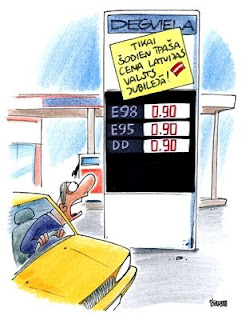 Cartoon: Gatis Šļūka
There is ongoing debate about the dire straits of the ruling Peoples party (TP), that does not have neither the post of the PM nor the Maire's office in the City of Riga. Latvian ruling parties traditionally have built their winning strategies prior municipal and parliamentary elections from the position being in power. To achieve their goal TP needs to achieve favourable coalition government prior the Latvian municipal elections in June 2005. The TP new leader and the Minister of Interior Mr Mareks Segliņš announced that he would not mind taking the opposition Reconciliation Party (SC) into the new governing coalition.
we take Riga...
I guess that this is simply testing the grounds for rather simple plan to start the remodelling of the existing coalition governments from the Riga municipality. In Latvian micro state almost half of the Latvian population resides in the Riga metropolitan area. Thus, similarly to other small states (Estonia or Iceland) whenever there are changes on the national level they also trigger changes on the level of the biggest municipality.
Preparations for the change in the Riga Major's office has started, because also transport supremo Šlesers is interested in this post. He is so much interested in this post that allowed himself a frivolity to retort to journalist question, whether chances of the present MEP Ģirts Valdis Kristovskis (Citizens Union) to become the new maire of Riga are good, as simply negligent...(«Nav vērts izteikties par tiem, kuriem nav nekādas izredzes vadīt Rīgu.»)
My hunch is that the TP is interested to get the Maire's office prior elections in the June 2009. It has been rumoured that the Riga Vice Maire Andris Ārgalis (typical Soviet hozaistvennik) is keen to assume that post. TP has nine seats in the Riga municipality now, while SC has seven, the First and Latvian Way Party union (LPP) eight, and Social Democrats (LSDSP) have five seats. In order to trigger the fall of the present Maire of Riga Mr Jānis Birks (Fatherland Party-TB/LNNK) TP leaders must appease Social democrats and RC party with positions that are lucratively enough. If they achieve that then they can with their present partners from the LPP form the thirty one seat majority in the sixty member Riga City Council. If they would feel that 31 seat majority is too scanty, then they can always count on the four mavericks from the Motherland Party (Dzimtene) and Socialists Union.
and Latvia after it...
If such plan would work out TP would achieve thus needed bridgehead position and administrative resources prior the 2009 municipal elections. It could possibly trigger the fall of the present governing coalition. It has been rumoured that president Zatlers would nominate the incumbent PM again, and the TP would actually be happy with such a turn of events. Overcoming the hardest economic crisis is entrusted to the crisis manager Ivars Godmanis, and thus it is assumed that all the blame in public relations sphere would be transferred to LPP. Also it could allow to take SC into government, because there is not enough lucrative positions on the municipal level. In this case the parties that would fall into disgrace would be TB/LNNK and the Union of Greens and Farmers (ZZS). The number of TP (21), SC(18), and LPP(10) seats is enough now to have a new minority coalition in the 100 member Saeima, and if some of the PCTVL MP's would be co opted, then they could even have a slight majority.
It could officially report the death knell for the TB/LNNK parliamentary representation. TP would get rid of the ZZS, that they are unhappy with due to disagreements on the territorial administrative reform ,and due to the Maire of Ventspils ambivalent role in today's distribution of government perks. Also it could allow TP to swing into the race for the 2010 parliamentary elections. Allowing leftist SC in the government TP could traditionally blame the LPP premier and leftist SC for all the ills somewhere after the 2010 Midsummer. Thus, it would allow TP together with the opposition right wing parties (JL, PS, SCP) to propose somewhere around this time to form a "genuine" right wing coalition TP-21, JL-14, ZZS-17 and with their PM candidate (Kristiāna Lībane - Šķēle) to prepare for the 10th Saeima elections.
This is just my speculation which could be achieved if we assume that the major actors of the political field are static. First, it will be outcome of the European Parliament and the municipal elections that would determine the relative balance of political forces prior the October 2010. Second, the, international economy is an intervening variable that could trigger activation of the civil society and fostered role of the opposition parties. The present situation looks rather uncertain with the global recession hitting the Latvian economy hard. The potential for the clean-up of the Latvian political system looks promising while looking from the perspective of the formative events at the end of the 2008 however. The choice is simple - to reform the post-Soviet education, political and economic structures or to become a murky dependency relying on the Russian oil and mineral resources transit commissions. I still hope in capacity of the Latvian people to change their thinking patterns and to proudly celebrate the Latvian 100th anniversary just ten years from now.
P.S. Those of you reading in Latvian can read a piece I wrote in Diena today.
Subscribe to:
Posts (Atom)